Giant telescope will keep an eye on planets in other solar systems
December 29th, 2004 Giant Magellan Telescope

MIT astrophysicists and their colleagues are excited about the latest milestone toward developing a giant telescope that among other things will allow direct observations of planets orbiting stars in solar systems beyond ours.
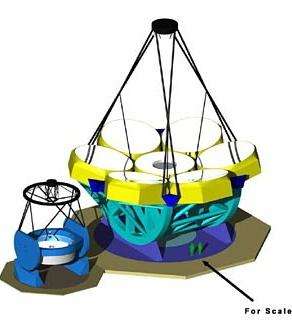
On Dec. 13 the Carnegie Observatories of the Carnegie Institution signed an agreement with the University of Arizona's Steward Observatory Mirror Lab to produce the first mirror for the Giant Magellan Telescope (GMT). The telescope will have a diameter of about 25.4 meters or 83 feet--making it about as wide as an eight-story building is tall.

Image: Schematic shows the 25.4-meter Giant Magellan Telescope next to a 6.5-meter Magellan telescope. The 83-foot giant telescope is as wide as an eight-story building is tall. Image courtesy: Carnegie Institution

Slated for completion in 2016 at Carnegie's Las Campanas Observatory in Chile, the GMT will have 10 times the resolution of the Hubble Space Telescope enabling a variety of new projects and observations.

"At the very top of that list would be the direct observation of exo-planets around nearby stars and observation of objects yet younger (and therefore more distant) than the youngest objects observable today," said Paul Schechter, the William A. M. Burden Professor of Astrophysics, who leads the MIT group that is part of the eight-member consortium developing the GMT.

Other members are Carnegie Observatories, Harvard University, Smithsonian Astrophysical Observatory, University of Arizona, University of Michigan, University of Texas at Austin, and Texas A&M University.

The new telescope will be composed of seven, 8.4-meter primary mirrors arranged in a floral pattern. It builds on the successful heritage of the two 6.5-meter Magellan telescopes, the first of which began science operations in early 2001. "The same individuals involved in the building of Magellan constitute the core of the GMT design group," Schechter said.

What role do ground-based telescopes play in the era of satellite telescopes like the Hubble? For one, said Schechter, "ground-based telescopes can be much bigger, which is important because a telescope's light-gathering power is proportional to the square of its diameter. The Hubble is only 2.4 meters in diameter, and the next-generation space telescope, which ought to be finished at about the same time as the GMT, will be smaller than the present Magellan telescopes."

Detailed information about the design of the GMT and the science that it will perform is located on the web (http://www.gmto.org/).

Source: MIT


print this article email this article download pdf blog this article bookmark this article     Digg this Stumble it share on Facebook share on Reddit add to delicious save to Yahoo! bookmarks
1/5 after 1 votes


December 29th, 2004 all stories
Space & Earth /

Comments: 0
Rank: 1/5 after 1 votes

  • Stumble this up

  • Digg this

  • Share it:
  • share on Facebook
  • share on MySpace
  • share on Slashdot
  • rss-newsfeed
  • share on Google
  • share on Reddit
  • add to delicious
  • save to Yahoo! bookmarks
  • share on Windows Live
  • Add to Mixx!
Rating: 1/5 after 1 votes

  • Related Stories

  • Peculiar, junior-sized supernova discovered by New York teen
    created Jun 11, 2009 | popularity not rated yet | comments 0
  • Nine institutions officially sign agreement for 25-meter Giant Magellan Telescope
    created Feb 06, 2009 | popularity not rated yet | comments 0
  • Exoplanet atmospheres detected from Earth for the first time
    created Jan 14, 2009 | popularity not rated yet | comments 0
  • Scientists discover minimum mass for galaxies
    created Aug 27, 2008 | popularity not rated yet | comments 0
  • Catching planets in the making
    created Apr 07, 2008 | popularity not rated yet | comments 0

Tags


  • Transform a ball into a rock -- or make it invisible -- using transformation optics
    Transform a ball into a rock -- or make it invisible -- using transformation optics
    Physics / General Physics
    created 10 hours ago | popularity 3.7 / 5 (3) | comments 0
  • Could a quantum motor do work?
    Physics / General Physics
    created Jul 07, 2009 | popularity 4 / 5 (12) | comments 0
  • Physicists Demonstrate Quantum Memory with Matter Qubits
    Physicists Demonstrate Quantum Memory with Matter Qubits
    Physics / General Physics
    created Jul 03, 2009 | popularity 4.5 / 5 (20) | comments 1
  • 'Holey' Nanosheets for Wastewater Dye Removal
    Nanotechnology / Nanomaterials
    created Jul 01, 2009 | popularity 5 / 5 (5) | comments 1
  • Jellyfish Robot Swims Like its Biological Counterpart
    Jellyfish Robot Swims Like its Biological Counterpart
    Electronics / Robotics
    created Jun 26, 2009 | popularity 4.4 / 5 (9) | comments 1
  • Other News

    Living fossils hold record of 'supermassive' kick

    Living fossils hold record of 'supermassive' kick

    Space & Earth / Astronomy

    created 2 hours ago | popularity 4.5 / 5 (2) | comments 1

    The tight cluster of stars surrounding a supermassive black hole after it has been violently kicked out of a galaxy represents a new kind of astronomical object and a fossil record of the kick.


    Methane-eating microbes can use iron and manganese oxides to 'breathe'

    Methane-eating microbes can use iron and manganese oxides to 'breathe'

    Space & Earth / Earth Sciences

    created 5 hours ago | popularity 4.7 / 5 (3) | comments 0

    Iron and manganese compounds, in addition to sulfate, may play an important role in converting methane to carbon dioxide and eventually carbonates in the Earth's oceans, according to a team of researchers ...


    Tremors on southern San Andreas Fault may mean increased quake risk

    Tremors on southern San Andreas Fault may mean increased quake risk

    Space & Earth / Earth Sciences

    created 4 hours ago | popularity not rated yet | comments 0

    (PhysOrg.com) -- Increases in mysterious underground tremors observed in several active earthquake fault zones around the world could signal a build-up of stress at locked segments of the faults and presumably ...


    A Galaxy Collision in Action

    A Galaxy Collision in Action

    Space & Earth / Astronomy

    created 4 hours ago | popularity 4.8 / 5 (4) | comments 1

    This beautiful image gives a new look at Stephan's Quintet, a compact group of galaxies discovered about 130 years ago and located about 280 million light years from Earth. The curved, light blue ridge running ...


    NASA sails through countdown, weather outlook poor (AP)

    NASA sails through countdown, weather outlook poor

    Space & Earth / Space Exploration

    created 3 hours ago | popularity not rated yet | comments 0

    (AP) -- NASA is sailing through the countdown for Saturday's launch of space shuttle Endeavour, with weather the lone concern.