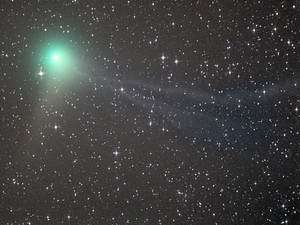
A Naked Eye Comet

January 3, 2005 Comet Macholz

Throughout January, astronomers in the northern hemisphere will be watching the recently discovered Comet Macholz as it tracks across the sky. It should be visible to the unaided eye until late January and well placed in the sky for UK observers.
During January, the comet will track northward, passing through the constellations of Taurus, Perseus and Cassiopeia as it heads toward the Pole Star, Polaris. In the first few days of the new year, it should be visible about 10 degrees to the west of the bright orange star Aldebaran (the “bull’s eye” in the V-shaped star pattern of Taurus).

On the night of January 7 - 8, it will sail about 2 degrees (4 Moon widths) to the west of the easily recognisable Pleiades star cluster, often known as the Seven Sisters.

The comet was discovered by Californian amateur astronomer Don Machholz on 27 August 2004. During early January it is about 52 million km from the Earth , though the distance increases after mid-month. It will be at its closest to the Sun (about 180 million km) on 24 January. However, rather unusually, the comet spends its entire life outside the orbit of the Earth.

To find Comet Machholz, it is best to select a dark observing site away from major cities and street lights. Anyone familiar with the winter sky should look to the right of the bright constellation of Orion and then search higher in the sky for Aldebaran and the Pleiades. In binoculars, look for an object that is fuzzy compared with the much more distant stars.

Source: Royal Astronomical Society (RAS)
Image Credit: Adam Block (NOAO), AURA, NSF


print this article email this article download pdf blog this article bookmark this article     Stumble it Digg this share on Facebook retweet share on Reddit add to delicious
Rate this story - not rated yet


January 3, 2005 all stories

Comments: 0

not rated yet
  • Stumble this up

  • Digg this

  • share this

  • hide
  • Related Stories

  • The 2009 Leonid Meteor Shower
    created Nov 10, 2009 | popularity not rated yet | comments 0
  • STAR TRAK for November: Mars is prominent again
    created Nov 02, 2009 | popularity not rated yet | comments 0
  • Orionid meteor shower peaks Wednesday
    created Oct 19, 2009 | popularity not rated yet | comments 0
  • Twin Keck telescopes probe dual dust disks
    created Sep 24, 2009 | popularity not rated yet | comments 0
  • Astronomers unveil an amazing, interactive, 360-degree panoramic view of the entire night sky
    created Sep 14, 2009 | popularity not rated yet | comments 0


Other News

Past regional cold and warm periods linked to natural climate drivers

Space & Earth / Earth Sciences

created 3 hours ago | popularity 5 / 5 (4) | comments 5

Intervals of regional warmth and cold in the past are linked to the El Niño phenomenon and the so-called "North Atlantic Oscillation" in the Northern hemisphere's jet stream, according to a team of climate scientists. These ...


Russia: no space for space tourists (AP)

Russia: no space for space tourists

Space & Earth / Space Exploration

created 11 hours ago | popularity 2.7 / 5 (3) | comments 2

(AP) -- A top Russian space official says there is no space for tourists wishing to fly to the International Space Station.


Monster Waves on the Sun are Real

Monster Waves on the Sun are Real (w/ Video)

Space & Earth / Astronomy

created 23 hours ago | popularity 4.9 / 5 (15) | comments 2

Sometimes you really can believe your eyes. That's what NASA's STEREO (Solar Terrestrial Relations Observatory) spacecraft are telling researchers about a controversial phenomenon on the sun known as the "solar ...


Climate experts debate strategies for reducing atmospheric carbon and future warming

Climate experts debate strategies for reducing atmospheric carbon and future warming

Space & Earth / Environment

created 23 hours ago | popularity 2.9 / 5 (9) | comments 14

(PhysOrg.com) -- Reducing carbon dioxide to safe levels may require extracting carbon from the air, says Cornell climate researcher.


Astronauts surprised by holiday turkey dinners (AP)

Astronauts surprised by holiday turkey dinners

Space & Earth / Space Exploration

created 6 hours ago | popularity not rated yet | comments 0

(AP) -- Space shuttle Atlantis' astronauts thought they were going to give thanks with pantry leftovers Thursday as their mission drew to a close, but found turkey dinners awaiting them.