DZero continues search for a possible light Higgs
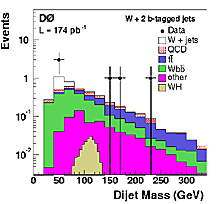
January 3, 2005 Distribution of the dijet invariant mass for W + 2b-tagged events

According to DOE Pulse, scientists of the DZero experiment at the Department of Energy's Fermilab have submitted results of the first Run II search for a light Higgs, hypothesized at 115 GeV/c**2. In this search, DZero looks for events where the W boson decays to leptons and the Higgs boson decays to a b-quark, anti b-quark pair.

Image: Distribution of the dijet invariant mass for W + 2b-tagged events: the 6 observed events (black circles) are compared to the simulated standard model contributions (cumulative histograms). The expectation for a 115 GeV Higgs boson from WH production is also shown (brown histogram). (Credit: DOE Pulse)

The real data unfortunately shows no evidence that this is the scenario. But this non-observation allows DZero to set new limits on the critical W-Higgs production rate, which can set limits on theoretical ideas outside the standard model. And it holds out some hope that the Tevatron might produce evidence of a light Higgs.

The DØ Experiment consists of a worldwide collaboration of scientists conducting research on the fundamental nature of matter. The experiment is located at the world's premier high-energy accelerator, the Tevatron Collider, at the Fermi National Accelerator Laboratory (Fermilab) in Batavia, Illinois, USA. The research is focused on precise studies of interactions of protons and antiprotons at the highest available energies. It involves an intense search for subatomic clues that reveal the character of the building blocks of the universe.

Source: DOE Pulse


print this article email this article download pdf blog this article bookmark this article     Stumble it Digg this share on Facebook retweet share on Reddit add to delicious
Rate this story - 1 /5 (1 vote)

Rank Filter

Move the slider to adjust rank threshold, so that you can hide some of the comments.


Display comments: newest first

  • jonnyboy - Mar 12, 2009
    • Rank: 1 / 5 (1)
    This article is absurd. If I hypothesize, for example, that the sun is going to explode tomorrow and then find no proof of my own hypothesis. IT AINT SCIENCE!!!!!!!!!!!!!

January 3, 2005 all stories

Comments: 1

1 /5 (1 vote)
  • Stumble this up

  • Digg this

  • share this

  • hide
  • Related Stories

  • Particle oddball surprises physicists
    created Mar 18, 2009 | popularity not rated yet | comments 0
  • New experiments constrain Higgs mass (w/Videos)
    created Mar 13, 2009 | popularity not rated yet | comments 0
  • Fermilab collider experiments discover rare single top quark
    created Mar 09, 2009 | popularity not rated yet | comments 0
  • The hunt for the Higgs steps up a gear
    created Aug 28, 2008 | popularity not rated yet | comments 0
  • Prelude to the Higgs: A work for 2 bosons in the key of Z
    created Jul 30, 2008 | popularity not rated yet | comments 0


Other News

Do we need dark matter?

Do we need dark matter?

Physics / General Physics

created Nov 12, 2009 | popularity 4.1 / 5 (14) | comments 28

It's the biggest problem in physics: the matter we can see in the universe accounts for just five per cent of the observed gravity that holds galaxies together.


A line on string theory

A line on string theory

Physics / General Physics

created Nov 12, 2009 | popularity 4.7 / 5 (40) | comments 14

(PhysOrg.com) -- A Harvard theoretical physicist has discussed with scientists at the Large Hadron Collider in Switzerland the possibility that they may discover a theorized "stau" particle, with a lifetime ...


The LHC tunnel

Peckish bird briefly downs big atom smasher

Physics / General Physics

created Nov 09, 2009 | popularity 4.2 / 5 (13) | comments 20

A peckish bird briefly knocked out part of the world's biggest atom smasher by causing a chain reaction with a piece of bread, the European Organisation for Nuclear Research (CERN) said Monday.


Pushing light beyond its known limits

Pushing light beyond its known limits

Physics / Optics & Photonics

created Nov 12, 2009 | popularity 4.1 / 5 (14) | comments 5

Scientists at the University of Adelaide have made a breakthrough that could change the world's thinking on what light is capable of.


First Bose-Einstein condensation of strontium

First Bose-Einstein condensation of strontium

Physics / Quantum Physics

created Nov 09, 2009 | popularity 4.8 / 5 (10) | comments 5

In an international first, scientists from the Institute of Quantum Optics and Quantum Information (IQOQI, Austria) produced a Bose-Einstein condensate of the alkaline-earth element strontium, thus narrowly ...