Saturn's Icy Moon Iapetus
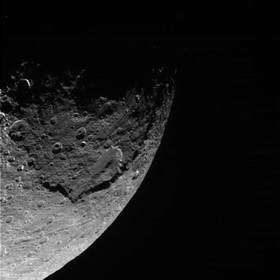
NASA's Cassini spacecraft successfully flew by Saturn's moon Iapetus at a distance of 123,400 kilometers (76,700 miles) on Friday, Dec. 31. NASA's Deep Space Network tracking station in Goldstone, Calif., received the signal and science data that day beginning at 11:47 p.m. Pacific Standard Time.
Iapetus is a world of sharp contrasts. The leading hemisphere is as dark as a freshly-tarred street, and the white, trailing hemisphere resembles freshly-fallen snow.
Image: This image of Iapetus was taken on Dec. 31, 2004 at a range of about 71,978 kilometers (44,725 miles) from the icy moon.
Friday's flyby was the first close encounter of Iapetus during the four-year Cassini tour. The second and final close flyby of Iapetus is scheduled for 2007. Next up for Cassini is communications support for the European Space Agency's Huygens probe during its descent to Titan on Jan. 14.
The Huygens probe successfully detached from the Cassini orbiter on Dec. 24. The data gathered during the descent through Titan's atmosphere will be transmitted from the probe to the Cassini orbiter. Afterward, Cassini will point its antenna to Earth and relay the data through NASA's Deep Space Network to NASA's Jet Propulsion Laboratory, Pasadena, Calif., and on to the European Space Agency's Space Operations Center in Darmstadt, Germany, which serves as the operations center for the Huygens probe mission. Two of the instruments on the probe -- the camera system and the gas chromatograph/mass spectrometer -- were provided by NASA.
Source: NASA


