Holes in Fossil Shells Show Effects of Competition and Evolution
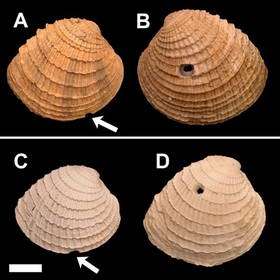
Fossil records of the holes drilled in clam shells before and after a mass extinction two million years ago show patterns of predator-prey behavior indicating that although diversity recovered rapidly, the level of competition has not, according to an article in the journal Science.
The study emphasizes a new way of looking at the consequences of extinction and recovery, by closely observing how individual species interact with each other.
Image: Examples of predatory shell drilling. (A and B) Edge- and wall-drilling traces from snail preying on clams under experimental lab conditions. (C and D) Edge- and wall-drilling traces in clam shell fossils. Courtesy of Science
"Our work shows that scientists have been looking at only half the story when they talk about the consequences of extinction," said Gregory P. Dietl, a post-doctoral fellow in geology and geophysics at Yale and co-author of the study. "Although measuring biodiversity -- or the span of species that exist -- is important, it does not necessarily tell us how ecosystems function."
Marine snails feed on clams by drilling a hole through the shell to reach the soft body inside. Using a rasping tongue and a cocktail of chemicals to drill through the wall of the shell takes several days, but under stress of competitive pressure, snails attack through the shell edge -- a faster, but riskier access.
The shift in feeding behavior patterns was demonstrated in the lab, and shown in the fossil record bridging the extinction and recovery of marine species in the western Atlantic at the end of the Pliocene Era. In the lab, under competitive conditions, 37.5% of the shells showed edge drilling, while only 2.6% did in unstressed conditions. Pliocene fossils had edge drilling present in 15 of 23 (65.2%) localities. In striking contrast, none of the shells from the early Pleistocene, middle Pleistocene, or Recent showed any signs of edge drilling.
These results demonstrate how extinction may alter competitive behaviors of surviving species, affecting subsequent recovery and evolution.
According to Dietl, this approach has practical implications for conservation biologists interested in managing the effects of current natural and human-induced extinctions. It is also a perspective that can guide policy-makers in facing the challenges of our interactions with the biosphere and the consequences of species loss.
Co-authors are Gregory S. Herbert, currently at the University of South Florida, and Geerat J. Vermeij at University of California, Davis. The work was supported by the National Science Foundation, the Geological Society of America, the Paleontology Society, the University of California and the University of North Carolina.
Citation: Science 306: 2229-2231 (December 24, 2004)
Source: Yale University


