The first detection of magnetic fields in the central stars of four planetary nebulae
For the first time, a team of astronomers based in Germany has detected the presence of magnetic fields in the central stars of four planetary nebulae. Planetary nebulae are expanding gas shells that remain after Sun-like stars eject their outer layers at the end of their lifetimes. It is a long-standing and unsolved mystery why 80% of all planetary nebulae are not spherical. Theories suggest that magnetic fields play a role in shaping planetary nebulae. The team, led by Stefan Jordan, has now discovered the first direct clue that magnetic fields might indeed create these remarkable shapes.
Planetary nebulae are expanding gas shells that are ejected by Sun-like stars at the end of their lifetimes. Sun-like stars spend most of their lifetime burning hydrogen into helium. At the end of this hydrogen fusion phase, these stars increase their diameter by about a factor of 100 and become “red giant stars”. At the end of the red giant phase, the outer layers of the star are blown away. The ejected gas continues to expand out from the remaining central star, which later evolves into a “white dwarf” when all nuclear fusion has ceased. Astronomers believe that a planetary nebula forms when a fast stellar wind that comes from the central star catches up a slower wind produced earlier when the star ejected most of its outer layers. At the boundary between the two winds, a shock occurs that produces the visible dense shell characteristic of planetary nebulae. The gas shell is excited and lighted up by the light emitted by the hot central star. The light from the central star is able to light up the planetary nebula for some 10 000 years.
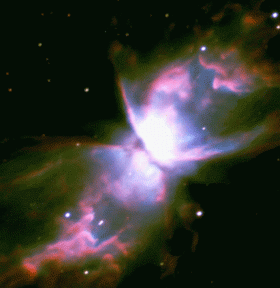
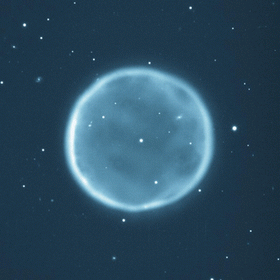
The observed shapes of planetary nebulae are very puzzling: most of them (about 80%) are bipolar or elliptical rather than spherically symmetric. This complexity has lead to beautiful and amazing images obtained with modern telescopes. The pictures below compare planetary nebulae with bipolar (fig. 1) and spherical (fig. 2) shapes.
The reason why most planetary nebulae are not spherical is not well understood. Several hypotheses have been considered so far. One of them suggests that the strange shapes of planetary nebulae might be due to some centrifugal effect that results from the fast rotation of red giants. Another theory is that the symmetry of the star's wind may be affected by a companion star. However, the most recent and convincing theories explaining the shapes of the nebulae involve magnetic fields.
The presence of magnetic fields would nicely explain the complicated shapes of planetary nebulae, as the ejected matter is trapped along magnetic field lines. This can be compared to iron filings trapped along the field lines of a bar magnet - a classic demonstration in high school physics classrooms. Since strong magnetic fields at the surface of the star also exert pressure on the gas, matter can more easily leave the star at the magnetic poles where the magnetic field is strongest.
There are several ways magnetic fields can be created in the vicinity of planetary nebulae. Magnetic fields can be produced by a stellar dynamo during the phase when the nebula is ejected. For a dynamo to exist, the core of the star must rotate faster than the envelope (as is the case in the Sun). It is also possible that the magnetic fields are fossil relics of previous stages of stellar evolution. Under most circumstances, the matter in stars is so highly electrically conductive that magnetic fields can survive for millions or billions of years. Both mechanisms, combined with the interaction of the ejected matter with the surrounding interstellar gas, would be able to shape the planetary nebulae.
Until recently, the idea that magnetic fields are an important ingredient in the shaping od planetary nebulae was a purely theoretical claim. In 2002, the first indications of the presence of such magnetic fields were found. Radio observations revealed magnetic fields in circumstellar envelopes of giant stars. These circumstellar envelopes are indeed progenitors of planetary nebulae. However, no such magnetic field has ever been observed in the nebulae themselves. To obtain direct clue of the presence of magnetic fields in planetary nebulae, astronomers decided to focus on the central stars, where the magnetic fields should have survived.
This first direct evidence has now been obtained. For the first time, Stefan Jordan and his team [1] detected magnetic fields in several central stars of planetary nebulae. Using the FORS1 spectrograph of the 8-m class Very Large Telescope (VLT, European Southern Observatory, Chile), they measured the polarization of the light emitted by four of these stars. The polarization signatures in the spectral lines make it possible to determine the intensity of the magnetic fields in the observed stars. In the presence of a magnetic field, atoms change their energy in a characteristic way; this effect is called the Zeeman effect and was discovered in 1896 by Pieter Zeeman in Leiden (Netherlands). If these atoms absorb or emit light, the light becomes polarized. This makes it possible to determine the strength of the magnetic field by measuring the strength of the polarization. These polarization signatures are usually very weak. Such measurements require very high quality data that can only be obtained using 8-meter class telescopes such as the VLT.
Four central stars of planetary nebulae were observed by the team and magnetic fields were found in all of them. These four stars were chosen because their associated planetary nebulae (named NGC 1360, HBDS1, EGB 5, and Abell 36) are all non-spherical. Therefore, if the magnetic field hypothesis to explain the shapes of planetary nebulae is correct, these stars should have strong magnetic fields. These new results show that it is indeed the case: the strengths of the detected magnetic fields range from 1000 to 3000 Gauss, that is about one thousand times the intensity of the Sun’s global magnetic field.
These new observations published by Stefan Jordan and his colleagues support the hypothesis that magnetic fields play a major role in shaping planetary nebulae. The team now plans to search for magnetic fields in the central stars of spherical planetary nebulae. Such stars should have weaker magnetic fields than the ones just detected. These future observations will allow astronomers to better quantify the correlation between magnetic fields and the strange shapes of planetary nebulae.
In the few past years, polarimetric observations with the VLT have led to the discovery of magnetic fields in a large number of stellar objects in late evolutionary stages. In addition to improving our understanding of these beautiful planetary nebulae form, the detection of these magnetic fields allows science to take a step forward towards the clarification of the relationship between magnetic fields and stellar physics.
[1] Stefan Jordan (Heidelberg, Germany), Klaus Werner (Tübingen, Germany) and Simon O'Toole (Bamberg, Germany).
Source: Journal Astronomy & Astrophysics


