Scientists prepare for Huygens descent on Titan
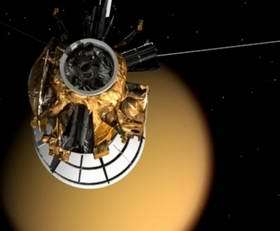
University of Arizona scientists, working on one of the most stunning robotic space missions ever attempted, head for Germany next week.
Their experiments ride on the Huygens probe to Saturn's giant moon, Titan, part of the four-year NASA/European Space Agency/Italian Space Agency Cassini Huygens mission to the Saturn system.
The probe separated from the Cassini spacecraft early Saturday, Dec. 25, 2004, central European time (or about 8:30 p.m. Dec. 24, Arizona time). Huygens is now on its 14,000 mile-per-hour, 20-day cruise toward Titan. The probe will parachute onto Titan's surface on Jan. 14 - the most distant touchdown any human-made object will have ever made in the solar system.
The European Space Agency (ESA), which owns and manages the Huygens probe, controls probe operations at the European Space Operations Center (ESOC) in Darmstadt, Germany. About a dozen UA researchers (listed below) will join their international colleagues in Darmstadt, which is near Frankfurt, for adrenalin-charged science operations on Jan. 14 and 15.
Titan - a world larger than Mercury and Pluto - is the only moon in the solar system with an atmosphere. Its mostly nitrogen atmosphere may resemble Earth's before life began. Scientists theorize that methane rains from Titan's sky, creating surface methane or ethane lakes, which may give rise to clouds, similar to the water cycle on Earth.
Scientists will study Titan's thick atmosphere, clouds and virtually unseen surface with six science experiments on Huygens during the probe's roughly 2.5-hour descent.
Martin Tomasko of the UA's Lunar and Planetary Laboratory (LPL) leads the international team with the only optical instrument on the probe. Tomasko and eight other LPL researchers, plus their colleagues, will be at ESOC analyzing data from the Descent Imager/Spectral Radiometer (DISR). DISR will study aerosol particles in Titan's atmosphere and take photographs of the surface for more than two hours as the probe spins downward. Huygens will relay data to the Cassini orbiter, which then transmits the signals to NASA's Deep Space Network. It takes 67 minutes for Cassini's signals to reach Earth.
UA planetary sciences Professor Jonathan I. Lunine is one of three interdisciplinary scientists on the Huygens probe. LPL Research Associate Ralph D. Lorenz, author of the book "Lifting Titan's Veil" and member of the Cassini radar team, is a co-investigator on the Surface Science Package. Planetary sciences Regents' Professor Donald M. Hunten is a co-investigator on Huygen's Gas Chromatograph-Mass Spectrometer.
The Descent Scenario
A system of alarm clocks will wake Huygens at a pre-programmed time a few hours before it slams into Titan's outermost atmosphere, more than 800 miles (1,270 kilometers) above Titan's surface.
During the first three minutes inside the atmosphere, Huygens must decelerate from more than 13,000 mph (21,000 kph) to 1,100 mph (1,800 kph). Temperatures on the face of Huygens' heat shield are expected to soar from 300 degrees below zero to more than 3,000 degrees Fahrenheit (minus 150 degrees to plus 1,800 degrees Celsius).
After Huygens hits the atmosphere at about 110 miles (180 km) above Titan's surface, robotic controls will open a pilot parachute to pull out the 27-foot (8.3 meter) main parachute at a speed of about 1,100 miles per hour (1,500 kph). Within a minute, the speed will drop to about 200 mph (320 kph).
The shell of the entry assembly module will then fall away, exposing the scientific instruments at about 100 miles (160 kilometers) above Titan's surface. Scientists estimate that the atmospheric temperature at this altitude is minus 250 degrees Fahrenheit (minus 120 degrees Celsius). DISR will begin taking images 93 miles (150 km) above the surface.
At about 75 miles (120 km ) altitude, Huygens will jettison its main parachute and deploy a third, 10-foot-diameter (3-meter-diameter) parachute for the remainder of the descent. Instruments should continue taking data for another 2 hours and 15 minutes and perhaps more.
Scientists hope that DISR will emerge from the thick Titan haze layer at about 43 miles (70 km) above the surface for clear views down. The probe will hit the coldest layer of the atmosphere, the tropopause, at about 28 miles (45 kilometers), where expected temperatures hover around minus 390 degrees Fahrenheit (minus 200 degrees Celsius).
DISR's three cameras will take about 750 images, or 250 "triplet" images, as the probe spirals toward Titan's surface. The DISR team will mosaic these images into 20 panoramic views of the ground and horizon in various resolutions.
At an altitude of 12 miles (20 km), all DISR data are relayed back to the Cassini orbiter to ensure that it won't be lost on touchdown impact.
At 6 miles and 3 miles (10 km and 5 km), DISR will take light spectra reflected from Titan's surface. The team will create a spectral map to determine the color and, from that, the composition of surface features.
At two-fifths of a mile (700 meters) above the surface, a 20-watt lamp on DISR will switch on and replace the colors of sunlight filtered out by Titan's atmospheric methane.
The probe has enough battery power for instruments to continue taking data for more than 30 minutes on Titan's surface -- if they survive landing. The force of landing will be like "riding your bicycle into a brick wall," said DISR team leader Martin Tomasko. The Cassini orbiter can receive Huygens ground data until it travels beyond Titan's horizon.
First Huygens Views and Results from Titan
The DISR team expects to receive its first dataset after 8 p.m. on Friday, Jan. 14, (Central European time). Bashar Rizk coordinates the DISR team that plans to produce a first panorama and perhaps even a simple movie during the early morning hours of Jan. 15. At the same time, Martin Tomasko and others will be analyzing data on atmospheric particles for their preliminary report on Titan's atmosphere.
The DISR team will release its first results at a Jan. 15 morning news conference at ESOC, where the European Space Agency is focusing media activities.
Those results also will be released Jan. 15 in Tucson, Ariz., at an evening public program in the Kuiper Space Sciences Building on the UA campus. LPL's David Kring, director of the NASA/University of Arizona Space Imagery Center, and DISR team member Lyn Doose will present first DISR results at the program, "Descending to a New World." Kring also is organizing a program for Saturday, Jan. 22, that will feature talks by Martin Tomasko and Jonathan Lunine, just back from ESOC. (Details on these events will be outlined in separate UA News releases.)
The DISR Intrument
DISR has many individual instruments to measure the makeup of atmospheric aerosol particles and take images of the Titan's surface. These are upward and downward looking violet photometers, a four-channel solar aureole camera, upward and downward looking visible and infrared spectrometers, surface science lamp, sun sensor and a three-channel imaging system.
The imaging system has a high-resolution imager, a medium-resolution imager and a side-viewing imager. Images from each of the three cameras are combined into a "triplet." Triplets are combined with other triplets to create mosaics, or panoramic views, of the surface.
Before it was launched, the imaging system was tested at a fire tower in the Santa Catalina Mountains north of Tucson, from the LPL rooftop on the UA campus and on helicopter flights over the town of Red Rock, Ariz., north of Tucson, and over Patagonia Lake, south of Tucson. Mosaics created in these tests gave researchers a good estimate of how the camera should perform during the Titan descent and will help them interpret DISR images.
There are actually several DISR flight-ready units - the one launched on the Huygens probe, a second flight model in Germany and a third replica instrument used at LPL in lab tests - and a fourth engineering DISR model.
Source: University of Arizona


