Aerodynamic Improvements & Flow Control System Boost Fuel Efficiency in Heavy Trucks
Flow control techniques and aerodynamic improvements developed at the Georgia Institute of Technology could save the U.S. trucking industry hundreds of millions of gallons of fuel per year.
Recent tests done using a full-size tractor-trailer truck show the techniques – which are based on systems originally developed for jet aircraft wings – could increase fuel economy by as much as 11-12 percent. The improvements could also enhance braking and directional control, potentially improving safety for the big vehicles.
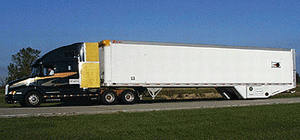
Image: Side view of test truck shows aerodynamic improvements made to reduce drag and improve fuel efficiency. Georgia Tech Photo
"Aerodynamically, we have resolved unknowns raised in earlier testing, and the next step is to get this into a fleet of trucks for more extensive testing," said Robert Englar, principal research engineer in the Aerospace, Transportation and Advanced Systems Laboratory of the Georgia Tech Research Institute (GTRI).
"We have shown that this technology now works quite successfully, and we expect that the industry will find a potential 12 percent fuel economy improvement worth pursuing," he added. "At highway speeds, each one percent improvement in fuel economy results in saving of about 200 million gallons of fuel for the U.S. heavy truck fleet."
The aerodynamic improvements produced by geometry changes – which generate fuel savings of as much as six to seven percent -- involve rounding aft trailer corners, installing fairings and making other changes that smooth air flow over the boxy trailers. Fuel savings of an additional five percent come from pneumatic devices that blow air from slots at the rear of the trailer to further improve and prevent separation of air flow.
Supported by the U.S. Department of Energy, the project began in the late 1990s with tests of simple scale model tractor-trailers in GTRI’s low-speed wind tunnel. Those studies suggested the possibility of dramatic fuel savings based on these simple models, but in the first tests on a full-scale truck, the results fell short of expectations.
So researchers went back to their wind tunnel with more realistic truck models to study lessons learned from the first test.
Working with Volvo Trucks of North America and Great Dane Trailers – manufacturers of the basic tractor and trailer respectively – Englar’s research team and Smyrna prototype shop Novatek installed a new set of aerodynamic features and revised the blowing system at the rear of the trailer. A series of higher-speed test runs at the Transportation Research Center’s Ohio fuel-economy test track in September then demonstrated the real fuel savings that had been expected.
The tests involved operating a blowing-equipped test tractor-trailer for several different 45-mile runs around a 7.5-mile oval at highway speeds of 65 and 75 miles per hour. A control truck that did not have the aerodynamic improvements or pneumatic control system was operated under the same conditions to provide a comparison. For additional comparisons, the test truck was also run without the experimental blowing equipment.
Before the pneumatic control system can be widely used in trucks, however, researchers will have to choose the best source of compressed air for the blowing system, Englar notes. Options include a diesel-powered motor installed in the trailer like current refrigeration units, bleeding pressurized air from the truck’s supercharger, or a simple chain drive to turn air blowers from the trailer’s wheels.
Aerodynamic drag becomes dominant only at higher speeds, so the blowing would be turned off when the trucks were idling or operating at low speeds, Englar said.
To fully assess the energy savings, the researchers will have to accurately account for the power needed by the blowing system, which will cut into the fuel savings. And other practical issues – such as protecting the pneumatic surfaces from damage during docking – still must be resolved, though that effort is already underway.
Beyond boosting fuel efficiency, the pneumatic system can also provide a form of aerodynamic braking to assist the mechanical brakes. “Using the pneumatic systems, you can turn a low-drag configuration into a high-drag configuration in a very rapidly, giving you a lot more braking power,” Englar said.
Differential blowing could also improve control of trailers in crosswinds by helping compensate for the wind direction. “This would allow you to have the blown equivalent of an airplane rudder on the trailer, without any physical additions,” he explained. “Beyond increasing fuel efficiency, the pneumatic system could be a drag reducer, drag increaser, safety factor and a stabilizing device.”
Both the improved braking and directional control could be part of an automated system that would not require special attention from drivers.
Further energy savings could come using a pulsed pneumatic system, which preliminary wind-tunnel studies on wings have shown could produce the same aerodynamic efficiency with less energy consumed by the blowing system. Englar hopes to get further funding to study how this might affect the truck aerodynamics – as well as fuel consumption.
“Our suspicion is that by using pulsed blowing, you could reduce the blowing system’s fuel requirements by about half to three-quarters,” he said. “This would reduce the penalty for running this kind of a blown system.”
Source: Georgia Institute of Technology


