New Protein Holds Promise For Use In Medicine And Nanoscience
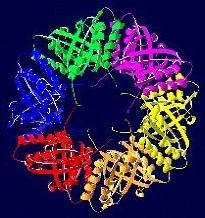
January 5, 2005 "Bagel-shaped" SP-1 protein

Researchers at the Hebrew University of Jerusalem have succeeded in discovering and isolating a new protein from the poplar tree with special structural and qualitative characteristics that could have consequences for development of future nanocapsules for drug delivery to cancer cells.

In addition to being obtained from plant tissue, the protein can now also be produced in large quantities as a recombinant protein in bacteria, making it highly available for medicinal or other applications.

Called SP-1, the protein has a nanometric, “bagel-shaped,” circular form and is extremely stable. It has been found to be capable of surviving contact with enzymes that break down proteins or exposure to extreme conditions such as boiling, excessive acidity, salinity, organic solvents or detergent solutions.

The research was conducted at the Hebrew University’s Faculty of Agricultural, Food and Environmental Quality Sciences in Rehovot by Prof. Arie Altman, head of the faculty’s Institute of Plant Sciences and Genetics in Agriculture, and Prof. Oded Shoseyov, with the participation of Dr. Wangxia Wang and Dr. Dan Pelah and the scientists of Fulcrum SP Ltd.: Dr. Amnon Wolf, Dr. Ira Marton and Dr. Yonatan Puny.

According to Profs. Altman and Shoseyov, the SP-1 protein serves to assist in creating a properly folded and functioning structure of other proteins within the plant’s cells. The SP-1 also has the ability to assemble itself into a structure composed of 12 identical units, making it exceptionally resistant to extreme conditions. These qualities are rarely found among proteins and make the SP-1 a promising candidate for a multiplicity of uses in developing medicinal applications in the rapidly growing field of nanobiotechnology.

SP-1 nanocapsules will be capable of delivering cell-destroying drugs specifically to certain types of solid cancer tumors. The protein’s tiny structure enables this carrier to penetrate specifically into tumors without harming healthy tissue and thus enhance the effectiveness of chemotherapy. This selective penetration is based on the fact that the blood vessels which feed tumors are considerably more porous than those reaching healthy cells. Therefore, the units of SP-1 carrying the drug would invade only the tumor-feeding blood vessels and not normal ones.

More recently, the three-dimensional structure of the protein was deciphered by x-ray crystallography. The research on this was published in the Journal of Biological Chemistry issue of December 2004, authored by graduate student Orna Dgany, Prof. Altman and Prof. Shoseyov, in cooperation with Dr. Orna Almog of Ben-Gurion University of the Negev and Dr. Sharon Wolf of the Weizmann Institute of Science and other researchers.

Prof. Altman and Prof. Shoseyov are the scientific founders of the biotech start-up company Fulcrum SP Ltd. that is developing the SP-1 protein for cancer drug delivery and other applications.

Source:


print this article email this article download pdf blog this article bookmark this article     Stumble it Digg this share on Facebook retweet share on Reddit add to delicious
Rate this story - 1 /5 (1 vote)


January 5, 2005 all stories

Comments: 0

1 /5 (1 vote)
  • Stumble this up

  • Digg this

  • share this

  • hide
  • Related Stories

  • Wild pigs and deer do not spread GM corn via feces or accumulate transgenic residues in meat
    created Oct 26, 2009 | popularity not rated yet | comments 0
  • A nervous system drug-by-design
    created Oct 26, 2009 | popularity not rated yet | comments 0
  • Promising novel treatment for human cancer -- Chrysanthemum indicum extract
    created Oct 16, 2009 | popularity not rated yet | comments 0
  • Bacterium with grabber arms stops intruders
    created Oct 16, 2009 | popularity not rated yet | comments 0
  • Philips announces breakthrough in fully digital light detection technology
    created Oct 08, 2009 | popularity not rated yet | comments 0


Other News

carbon fiber

Ultra-Long Carbon Nanotubes Could Serve as Future Transmission Lines

Nanotechnology / Nanomaterials

created Nov 10, 2009 | popularity 4.9 / 5 (20) | comments 13

(PhysOrg.com) -- When it comes to carbon nanotubes, the majority of research so far has focused on small-scale applications. But now, a team of researchers from Rice University has created carbon nanotubes ...


Researchers turn algae into high-temperature hydrogen source

Researchers turn algae into high-temperature hydrogen source

Nanotechnology / Nanophysics

created Nov 12, 2009 | popularity 3.6 / 5 (7) | comments 5

In the quest to make hydrogen as a clean alternative fuel source, researchers have been stymied about how to create usable hydrogen that is clean and sustainable without relying on an intensive, high-energy ...


Argonne 'homegrown' hybrid solar cell aims for low-cost power

Argonne 'homegrown' hybrid solar cell aims for low-cost power

Nanotechnology / Nanomaterials

created Nov 10, 2009 | popularity 4.2 / 5 (11) | comments 3

(PhysOrg.com) -- Scientists at the U.S. Department of Energy’s (DOE) Argonne National Laboratory have refined a technique to manufacture solar cells by creating tubes of semiconducting material and then "growing" ...


Nanoparticles for gene therapy improve

Nanoparticles for gene therapy improve

Nanotechnology / Bio & Medicine

created Nov 06, 2009 | popularity 5 / 5 (5) | comments 3

(PhysOrg.com) -- About five years ago, Professor Janet Sawicki at the Lankenau Institute in Pennsylvania read an article about nanoparticles developed by MIT's Robert Langer for gene therapy, the insertion ...


Engineers image nanostructure of a solid acid catalyst and boost its catalytic activity

Nanotechnology / Nanomaterials

created Nov 09, 2009 | popularity 5 / 5 (3) | comments 2

The catalytic processes that facilitate the production of many chemicals and fuels could become much more environmentally friendly thanks to a breakthrough achieved by researchers from Lehigh and Rice Universities.