Most Powerful Eruption in the Universe Discovered
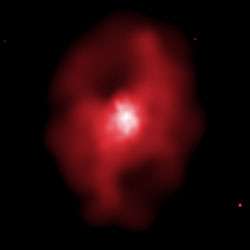
Astronomers have found the most powerful eruption in the universe using NASA's Chandra X-ray Observatory. A super massive black hole generated this eruption by growing at a remarkable rate. This discovery shows the enormous appetite of large black holes, and the profound impact they have on their surroundings.
The huge eruption was seen in a Chandra image of the hot, X-ray emitting gas of a galaxy cluster called MS 0735.6+7421. Two vast cavities extend away from the super massive black hole in the cluster's central galaxy. The eruption, which has lasted for more than 100 million years, has generated energy equivalent to hundreds of millions of gamma-ray bursts.
This Chandra image shows two vast cavities - each 600,000 light years in diameter - in the hot, X-ray emitting gas that pervades the galaxy cluster MS 0735.6+7421 (MS 0735 for short).
This event was caused by gravitational energy release, as enormous amounts of matter fell toward a black hole. Most of the matter was swallowed, but some of it was violently ejected before being captured by the black hole. "I was stunned to find that a mass of about 300 million suns was swallowed," said Brian McNamara of Ohio University in Athens. "This is as large as another super massive black hole." He is lead author of the study about the discovery, which is in the January 6, 2005, issue of Nature.
Astronomers are not sure where such large amounts of matter came from. One theory is gas from the host galaxy catastrophically cooled and was swallowed by the black hole. The energy released shows the black hole in MS 0735 has grown dramatically during this eruption. Previous studies suggest other large black holes have grown very little in the recent past, and that only smaller black holes are still growing quickly.
"This new result is as surprising as it is exciting," said co-author Paul Nulsen of the Harvard-Smithsonian Center for Astrophysics, Cambridge, Mass. "This black hole is feasting, when it should be fasting."
Radio emission within the cavities shows jets from the black hole erupted to create the cavities. Gas is being pushed away from the black hole at supersonic speeds over a distance of about a million light-years. The mass of the displaced gas equals about a trillion suns, more than the mass of all the stars in the Milky Way.
The rapid growth of super massive black holes is usually detected by observing very bright radiation from the centers of galaxies in the optical and X-ray wavebands, or luminous radio jets. In MS 0735 no bright central radiation is found, and the radio jets are faint. The true nature of MS 0735 is only revealed through X-ray observations of the hot cluster gas.
"Until now we had no idea this black hole was gorging itself," said co-author Michael Wise of the Massachusetts Institute of Technology, Cambridge, Mass. "The discovery of this eruption shows X-ray telescopes are necessary to understand some of the most violent events in the universe."
The astronomers estimated how much energy was needed to create the cavities by calculating the density, temperature and pressure of the hot gas. By making a standard assumption that 10 percent of the gravitational energy goes into launching the jets, they estimated how much material the black hole swallowed.
Besides generating the cavities, some of the energy from this eruption should keep the hot gas around the black hole from cooling, and some of it may also generate large-scale magnetic fields in the galaxy cluster. Chandra observers have discovered other cavities in galaxy clusters, but this one is easily the largest and the most powerful.
NASA's Marshall Space Flight Center, Huntsville, Ala., manages the Chandra program for NASA's Space Mission Directorate, Washington. Northrop Grumman of Redondo Beach, Calif., was the prime development contractor for the observatory. The Smithsonian Astrophysical Observatory controls science and flight operations from the Chandra X-ray Center in Cambridge, Mass.
Source: NASA


