Elegant shape of Eiffel Tower solved mathematically
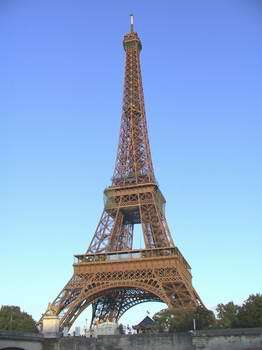
An American engineer has produced a mathematical model explaining the elegant shape of the Eiffel Tower that was derived from French engineer Gustave Eiffel's writings regarding his own fears about the effects of wind on such a structure.
University of Colorado at Boulder Associate Professor Patrick Weidman said Eiffel, one of the premier structural engineers in history, was determined to build the world's first tower reaching 300 meters, the nearest metric equivalent to 1,000 feet, into the sky. The tower was designed to be the centerpiece of the World's Exposition in Paris, marking the centennial of the French Revolution.
But such a tower, never having been successfully erected, raised a chronic concern of Eiffel that he expressed frequently in his communications.
"Eiffel was worried about the wind throughout his building career," said Weidman of the CU-Boulder mechanical engineering department. "Although he was astoundingly bright, he was forced to rely on practical experience rather than mathematical calculations to estimate the effects of wind forces on structures."
Weidman said the Eiffel Tower was not designed according to a single, overarching mathematical formula. Instead, Eiffel's engineers used graphical results to calculate the strength needed to support its tremendous weight, as well as empirical evidence to account for the effects of wind. "He built it section by section, and did not have an equation for its description," said Weidman.
But the spectacular tower, completed in 1889 and which remains one of the most romantic and recognizable structures in the world, has long been believed to be explainable using a mathematical equation, albeit a very complex one.
Weidman began researching the problem when he received a second edition copy of the textbook, "Advanced Engineering Mathematics," in 2001. The book's cover contains photographs of various stages of the Eiffel Tower's construction, and the book's preface contains a non-nonlinear integral equation -- a formula with a number of possible solutions -- for the tower's shape.
The equation was created by French Eiffel Tower aficionado Christophe Chouard, who posted it on his Web site and challenged engineers and mathematicians worldwide to find its solution, said Weidman. In terms of known mathematical functions, Weidman found one solution -- a downward facing parabola, but it has the wrong curvature for the legendary structure.
After giving a talk at Michigan Technological University in 2003, Weidman was introduced to Professor Iosif Pinelis, an expert in mathematical analysis, who offered his help in understanding the underlying features of the integral equation. Calculations by Pinelis showed that all existing solutions to Chouard's equation must be either parabola-like -- which the Eiffel Tower is not -- or "explode to infinity" at the top of the tower.
Weidman, who said he became obsessed with the problem, began to read more about the life of Eiffel and his construction efforts. He contacted Henri Loyette, author of a 1985 book on the life of Eiffel and now the curator of the Louvre in Paris, who suggested Weidman search the historical archives.
Weidman tracked down a copy of a communication from Eiffel to the French Society of Civil Engineers dated March 30, 1885. Written in French, the document affirmed that Eiffel planned to counterbalance wind pressure with the tension between the tower's construction elements.
After translating the 26-page document with the help of professional translator Claudette Roland, Weidman finally deduced the basis for tower construction. A key factor for Eiffel was determining where the tangents to the skyline profile -- which run from given horizontal sections of the tower -- intersect the resulting wind forces acting above those sections.
"Eiffel discovered this form of construction produces no load in the diagonal truss elements commonly used to counteract the bending moment, or torque, of the wind, and hence those truss members could be eliminated," Weidman said. "This allows for a reduction of the tower weight and reduces the surface area exposed to the wind."
Based on the information, Weidman derived a new equation for the skyline profile -- one that "embraces Eiffel's deep concern for the effects of wind-loading on the tower," he said. Weidman found an exact solution of the equation in the form of an exponential function that closely matches the shape of the tower's upper half.
The tower is composed of four arched, wrought-iron legs tapering inward to form a single column that rises to 300 meters, or 986 feet. The top level was built with a large room that Eiffel used for meteorological studies, capped by a spiral staircase and a television antenna that reaches to 1,052 feet today.
Plotting the actual shape of the tower reveals two separate exponential sections that are hooked together, he said. Since Eiffel did not seem confident in estimating the wind torque on the tower, he "overdesigned" the bottom section, beefing it up for safety reasons.
"The structural factor of safety is responsible for the second exponential equation describing the lower half of the tower," Weidman said.
Weidman and Pinelis presented their findings in a paper titled "Model Equations for the Eiffel Tower Profile: Historical Perspective and New Results."
The paper appeared in the July 2004 issue of the journal, "Comptes Rendus Mecanique," published by Elsevier and the French Academy of Sciences. In addition, the English translation of Eiffel's 1885 communication to the Society of French Engineers by Weidman and Roland recently was accepted for publication in the Architectural Research Quarterly published in Great Britain.
"While the events of the French Revolution are captured by Charles Dickens in his poignant novel, "A Tale of Two Cities," the centennial of the French Revolution is commemorated by Eiffel's graceful tower, the skyline profile of which is "A Tail of Two Exponentials," Weidman and Pinelis wrote in their 2004 paper.
The Eiffel tower, notes Weidman, "is a structural form molded by the wind." This was Eiffel's point more than a century ago, when he wrote about the four stout legs supporting the legendary tower: "Before they meet at such an impressive height, the uprights appear to spring out of the ground, moulded in a way by the action of the wind itself."


