Duct tape that never loses its stick
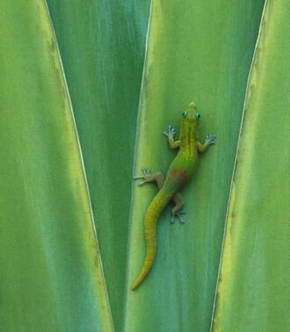
January 7th, 2005 Gecko

Gecko feet hold key to development of self-cleaning adhesives

Duct tape that never loses its stick. Bandages that come off without sticky residue or an "ouch." Gecko feet may hold the key to the development of synthetic self-cleaning adhesives, according to a biologist from Lewis & Clark College. The research is published in the January 3, 2005 online early edition of the Proceedings from the National Academy of Sciences of the United States, or PNAS.

“How geckos manage to keep their feet clean while walking about with sticky feet has remained a puzzle until now,” said Kellar Autumn, associate professor of biology at Lewis & Clark College. “Geckos don’t groom their feet, and the adhesive on their toes is much too sticky for dirt to be shaken off. Conventional adhesives like tape just get dirtier and dirtier, but we discovered that gecko feet actually become cleaner with repeated use.”

Autumn’s new research, published in PNAS, found that the microscopic adhesive hairs—or setae—that create the gecko’s adhesive qualities are also the first known self-cleaning adhesive. According to Autumn, gecko setae isolated from the gecko become cleaner by themselves.

“Our mathematical models suggest that self-cleaning in gecko setae is a result of geometry not chemistry,” said Autumn. “This means that synthetic self-cleaning adhesives could be fabricated from a wide variety of materials. The possibilities for future applications of a dry, self-cleaning adhesive are enormous. We envision uses for our discovery ranging from nanosurgery to aerospace applications. Who knows—maybe a gecko-inspired robot with sticky, self-cleaning feet will walk on the dusty surface of Mars someday.”

An interdisciplinary team of researchers, led by Autumn, earlier confirmed speculation that the gecko’s amazing climbing ability depends on weak molecular attractive forces called van der Waals forces, named after a Dutch physicist of the late 1800s. Van der Waals forces are weak electrodynamic forces that operate over very small distances but bond to nearly any material. Autumn’s research team rejected a 30-year-old model based on the adhesion chemistry of water molecules. Instead, the research team demonstrated that a gecko’s ability to stick to surfaces depends on geometry—not chemistry—to synthesize the world’s first gecko-based adhesive microstructure.

The setae (microscopic hairs) on the bottom of gecko’s feet are only as long as two diameters of a human hair. That’s 100-millionths of a meter long. Each seta ends with 1,000 even tinier pads at the tip. These tips, called spatulae, are only 200-billionths of a meter wide—below the wavelength of visible light. In 2002, Ronald Fearing, a researcher at the University of California at Berkeley, was able to produce two artificial hair tips, while Autumn and colleagues concluded that “both artificial setal tips stuck as predicted and provide a path to manufacturing the first dry, adhesive microstructures.” Fearing’s group later made the first array of synthetic gecko hairs with long stalks (6 micron stalk) and relatively large diameters (6 micron diameter).

The team’s research is supported by the National Science Foundation and the Defense Advanced Research Projects Agency (DARPA).

Source: Lewis & Clark College


print this article email this article download pdf blog this article bookmark this article     Digg this Stumble it share on Facebook share on Reddit add to delicious save to Yahoo! bookmarks
4.1/5 after 11 votes


January 7th, 2005 all stories
Physics /

Comments: 0
Rank: 4.1/5 after 11 votes

  • Stumble this up

  • Digg this

  • Share it:
  • share on Facebook
  • share on MySpace
  • share on Slashdot
  • rss-newsfeed
  • share on Google
  • share on Reddit
  • add to delicious
  • save to Yahoo! bookmarks
  • share on Windows Live
  • Add to Mixx!
Rating: 4.1/5 after 11 votes

  • Related Stories

  • Study of gecko feet leads to advances in the science of friction (w/Video)
    created Jun 04, 2009 | popularity not rated yet | comments 0
  • Discovered after 40 years: Moon dust hazard influenced by Sun's elevation
    created Apr 17, 2009 | popularity not rated yet | comments 0
  • Immune cells reveal fancy footwork
    created Dec 01, 2008 | popularity not rated yet | comments 0
  • Mimicking gecko feet: Dry adhesive based on carbon nanotubes gets stronger
    created Oct 09, 2008 | popularity not rated yet | comments 0
  • Engineers create new gecko-like adhesive that shakes off dirt
    created Sep 10, 2008 | popularity not rated yet | comments 0

Tags


  • Physicists Demonstrate Quantum Memory with Matter Qubits
    Physicists Demonstrate Quantum Memory with Matter Qubits
    Physics / General Physics
    created 11 hours ago | popularity 4.8 / 5 (8) | comments 1
  • 'Holey' Nanosheets for Wastewater Dye Removal
    Nanotechnology / Nanomaterials
    created Jul 01, 2009 | popularity 5 / 5 (5) | comments 1
  • Jellyfish Robot Swims Like its Biological Counterpart
    Jellyfish Robot Swims Like its Biological Counterpart
    Electronics / Robotics
    created Jun 26, 2009 | popularity 4.4 / 5 (7) | comments 1
  • Could Maxwell's Demon Exist in Nanoscale Systems?
    Could Maxwell's Demon Exist in Nanoscale Systems?
    Physics / General Physics
    created Jun 24, 2009 | popularity 4.4 / 5 (18) | comments 29
  • Living Safely with Robots, Beyond Asimov's Laws
    Living Safely with Robots, Beyond Asimov's Laws
    Electronics / Robotics
    created Jun 22, 2009 | popularity 4.6 / 5 (50) | comments 39
  • Other News

    Physicists Demonstrate Quantum Memory with Matter Qubits

    Physicists Demonstrate Quantum Memory with Matter Qubits

    Physics / General Physics

    created 11 hours ago | popularity 4.8 / 5 (8) | comments 1

    (PhysOrg.com) -- For the first time, scientists have successfully operated a quantum gate between two remote particles of matter, marking an important step toward the development of a quantum computer. In ...


    Scientists create first electronic quantum processor

    Scientists create first electronic quantum processor

    Physics / General Physics

    created Jun 28, 2009 | popularity 4.8 / 5 (49) | comments 38

    A team led by Yale University researchers has created the first rudimentary solid-state quantum processor, taking another step toward the ultimate dream of building a quantum computer.


    Fermilab's CDF observes Omega-sub-b baryon

    Fermilab's CDF observes Omega-sub-b baryon

    Physics / General Physics

    created Jun 29, 2009 | popularity 4.6 / 5 (13) | comments 7

    (PhysOrg.com) -- At a recent physics seminar at the Department of Energy’s Fermi National Accelerator Laboratory, Fermilab physicist Pat Lukens of the CDF experiment announced the observation of a new particle, ...


    New insights, and a new angle, on high-temperature superconductivity

    New insights, and a new angle, on high-temperature superconductivity

    Physics / Superconductivity

    created Jun 29, 2009 | popularity 4.8 / 5 (12) | comments 6

    (PhysOrg.com) -- A Princeton-led research team has revealed surprising information about how electron behavior influences the conduction of electricity in a class of high-temperature superconductors. An increased ...


    The art of invisibility and the perfect cat's eye

    The art of invisibility and the perfect cat's eye

    Physics / Optics & Photonics

    created Jun 30, 2009 | popularity 3.9 / 5 (7) | comments 6

    (PhysOrg.com) -- In recent years scientists have explored the impossible by developing invisibility or 'cloaking' devices, but can the same technology also help make things more visible?