Observation of material circling a supermassive black hole
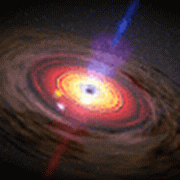
Astronomers from the University of Oxford and around the world have observed clumps of X-ray-emitting gas whipping around a black hole at 33,000 kilometres per second, one-tenth the speed of light.
The observation marks the first time scientists have been able to trace individual blobs of gas on a complete journey around a massive black hole, and provides crucial measurements that have long been missing from black hole studies: both an orbital period and an orbital speed. These have allowed the astronomers to calculate a lower limit to the black hole mass of 300,000 times that of our Sun.
The observation was made with the EPIC X-ray cameras on the European Space Agency's XMM-Newton satellite, and the team comprises Dr Jane Turner, of NASA's Goddard Space Flight Center and University of Maryland Baltimore County, Dr Lance Miller of Oxford University's Department of Physics, Dr James Reeves (NASA/GSFC) and Dr Ian George (NASA/GSFC and UMBC).
Dr Lance Miller said: 'If the black hole in question were placed in our Solar System, it would be as wide as Mercury's orbit, with the three clumps of matter detected orbiting as far out as Jupiter. They orbit the black hole in a lightning-quick 27 hours, compared to the 12 years it takes Jupiter to orbit the Sun.'
The EPIC instrument (European Photon Imaging Camera) used to make these observations was built by four countries, led by the University of Leicester where Professor Martin Turner is the Principal Investigator.
Professor Turner said: "When we designed the EPIC instrument for XMM-Newton, we hoped that it could be used to study the matter orbiting a black hole under its intense gravitational field. It is gratifying that scientists from the UK and the United States are able to do just that."
Black holes are regions in space so dense that gravity prevents all matter and light from escaping. What scientists see is not the black hole itself but rather the light emitted close to it as matter falls towards the black hole and heats to high temperatures. The scientists observed a well-known galaxy named Markarian 766, about 170 million light years away. The black hole there is relatively small, although still several million times as massive as our Sun, and highly active in swallowing gas and matter.
Matter funnels into this black hole like water swirling down a drain, forming what is called an accretion disk. Flares erupt on this disk through an unknown process. Dr Miller said: 'Calculating the flares' speeds and the black hole mass was straightforward, based on Doppler shifting, the phenomenon by which light appears to rise in energy as an object moves towards us and then fall in energy as it moves away. The 'eeeeeeyyoool' sound of a passing car on a motorway is a similar phenomenon, and Doppler shift is measured in the radar guns that police use to catch speeders.
'We think we're viewing the accretion disk at a slightly tilted angle, and we see the light from each of these flares rise and fall in energy as they orbit the black hole. With a measured velocity and orbital period, we could determine the black hole mass using relatively simple Newtonian physics.'
Two factors made the measurement possible. First, the scientists observed particularly persistent flares for nearly 27 hours. Second, no telescope before XMM-Newton has had the light-collecting power to allow for a comparison of energy over time.
The observation confirms an XMM-Newton result announced by a European team in September that some scientists had found speculative: that something as detailed as an orbital period could be detected with the current generation of telescopes. The results show that scientists, given long observation times, are now able to make measurements of black holes to test theories of how such extreme objects form at the centres of galaxies, and how they become active in swallowing gas and other matter.
Source: PPARC


