Spacetime wave orbits black hole: beyond Einstein's general relativity
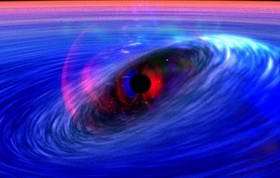
Astronomers from MIT and the Harvard-Smithsonian Center for Astrophysics have seen evidence of hot iron gas riding a ripple in spacetime around a black hole. This spacetime wave, if confirmed, would represent a new phenomenon that goes beyond Einstein's general relativity.
Astronomers have discovered evidence for physics beyond Einstein's general relativity. This artist's conception shows a galactic black hole being orbited by a ripple in spacetime—a distortion in the fabric of space itself. Image courtesy: Dana Berry/CfA/NASA
These observations, presented Jan. 10 at the 205th meeting of the American Astronomical Society in San Diego, confirm one important theory about how a black hole's extreme gravity can stretch light. The data also paint an intriguing image of how a spinning black hole can drag the very fabric of space around with it, creating a choppy spacetime sea that distorts everything falling into the black hole.
Jon Miller of the Harvard-Smithsonian Center for Astrophysics and Jeroen Homan of MIT's Center for Space Research observed the phenomenon with NASA's Rossi X-ray Timing Explorer.
"Black holes are such extreme objects that they can actually warp and drag the fabric of spacetime around with them as they spin," said Miller, who is the lead author on an article to be published in The Astrophysical Journal Letters. "Gas whipping around the black hole has no choice but to ride that wave. Albert Einstein predicted this over 80 years ago, and now we are starting to see evidence for it."
A black hole is a region in space where gravitational forces are so great that not even light can escape. Gas and dust funnel towards a black hole in an accretion disk, swirling around and into the void like water down a drain. This process of accretion generates copious amounts of light--predominantly X-ray radiation, particularly in the innermost (hottest) regions of the accretion disk. Near the black hole, gravity is rather intense, but light still can muster an escape by climbing out of the black hole's gravitational "well," losing energy during the climb. Thus, scientists can study black hole activity with X-ray telescopes like the Rossi Explorer.
Miller and Homan, for the first time, found a connection between two important characteristics of black hole observations: quasi-periodic oscillations (QPOs) and the broad iron K line. QPOs refer to the way the X-ray light seems to flicker. The broad iron K line refers to the shape of a spike on a spectrogram (a tool scientists use to analyze light characteristics such as energy). Light from iron atoms emitted at a specific frequency creates a bright line in the spectrogram. The line is broadened, or stretched to lower energies, because the light loses energy as it climbs out of a gravitational well.
Using the Rossi Explorer, Miller and Homan studied a black hole named GRS 1915+105, about 40,000 light years away in the constellation Aquila. They noticed that a low-frequency QPO of 1 to 2 hertz was tied to changes in the broad iron K line, as if the two features knew of each other. The fact that the two signals were in synch and were unaffected by other phenomena--such as black hole jet activity--strongly suggests that both are occurring very close to the black hole. And this, the scientists say, rules out a theory stating that broad iron lines are created in black hole winds far from the black hole itself.
This discovery raised the question of what could be causing the connection. "High-frequency QPOs are likely from matter racing around the black hole, glowing like lightbulbs on a merry-go-round," said Homan. "Of course, matter is moving much faster around a black hole than on any amusement park attraction. We see frequencies of hundreds of hertz, or hundreds of revolutions of the disk per second. That's quite a ride."
Lower-frequency QPOs are a deeper mystery. These are typically 1 to 10 hertz, and they're quite common in many binary star systems with black holes. Miller and Homan say that in the GRS 1915+105 system, the slower QPO could be the frequency of a spacetime warp. In that case, the low-frequency QPO flickering is caused by the fabric of space itself churning around the black hole in a wave. This is known as Lense-Thirring precession, which evolves out of Einstein's theory of general relativity.
Imagine the accretion disk as a music CD. (The Beach Boys come to mind.) The wave produced by the spacetime warp would increase the surface area of the flat disk. The broadness of iron K lines depends on surface area. So, this momentary increase in surface area, "flickering" at a frequency of 1 to 2 hertz, could explain the repetitive changes observed in the iron K line. Each time the hot iron gas encounters the spacetime warp, the light gets a jolt and the broad iron K line changes its appearance.
Miller and Homan caution that this is only one explanation of their observation, and that other explanations may be possible. What is clear, the scientists say, is that they are seeing a connection between QPOs and the broad iron K line, and this in turn means that scientists are probing more closely to black holes than ever before.
Source: MIT


