Astronomers Discover Largest Stars Known
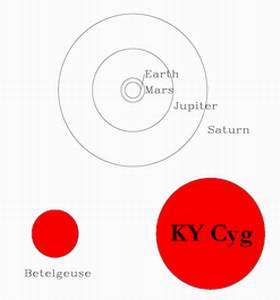
Astronomers are announcing today the identification of three red supergiants that have the largest diameters of any normal stars known (1500 times larger than the Sun), more than a billion miles across. The group of astronomers studied a sample of 74 red supergiant stars in the Milky Way. This research is significant in finally reconciling theory and observation for these stars. Red supergiants, massive stars nearing the ends of their lifetimes, are extremely cool and luminous – and very large.
Figure: The size of KY Cygni, a red supergiant star with one of the largest diameters known, is shown in comparison to Betelgeuse, the brightest star in the constellation of Orion, and one of the largest stars previously known. KY Cygni has a diameter of 1.3 billion miles according to the new study, about 1500 times larger than the Sun. Its size is so large that it would completely engulf the orbit of Jupiter if it were located in the Sun's position. Credit: Philip Massey, Lowell Observatory.
The report is being presented by Ms. Emily Levesque, an undergraduate junior at MIT, who has been working with an international team of astronomers, including Philip Massey (Lowell Observatory, in Flagstaff, Arizona), Knut Olsen (Cerro Tololo Inter-American Observatory, in Chile), Bertrand Plez and Eric Josselin (Universite de Montpellier II, in France), and Andre Maeder and Georges Meynet (Geneva Observatory, in Switzerland). Nat White of Lowell Observatory also participated in the study. The findings are being presented today at the American Astronomical Society meeting in San Diego, California.
The three stars with the largest known sizes are KW Sagitarii (distance 9,800 light-years), V354 Cephei (distance 9,000 light-years), and KY Cygni (distance 5,200 light-years), all with radii about 1500 times that of the Sun, or about 7 astronomical units (AU). For comparison, the well-known red supergiant star Betelgeuse in the constellation Orion is known from other work to have a radius about 650 times that of the Sun, or about 3 AU. If one of these stars were placed in the sun's location, its outer layers would extend to midway between the orbits of Jupiter (5.2 AU) and Saturn (9.5 AU) [see figure].
The previous record holder, Herschel's "Garnet Star" (also known as "mu Cephei") comes in a close fourth in size in the study. The only other star for which a very large size has been claimed is the binary star system VV Cephei, which consists of a red supergiant and a hot companion orbiting within a common gaseous envelope, in which the gravitational forces of the companion have distended the surface of the supergiant and the meaning of the size of the star is therefore fuzzy. None of the stars in the new study are believed to be binaries, and thus their properties tell us about the extreme sizes that normal stars reach.
The study used the National Science Foundation's 2.1-meter (84-inch) telescope at Kitt Peak National Observatory, located outside of Tucson, Arizona, and the 1.5-m (60-inch) telescope at Cerro Tololo Inter-American Observatory, located outside of La Serena, Chile, in the foothills of the Andes. The new observations were combined with state-of-the-art computer models that contain improved data on the molecules that are found in the outer layers of these cool stars. The analysis yielded the most accurate temperatures yet found for this type of object. The temperatures of the coolest red supergiants are about 3450 Kelvins, or about 10 percent warmer than previously thought. Combined with modern estimates of the distances of these stars, the group was able to determine the stellar sizes as well.
"The significance of this study is that for the first time in many decades there is good agreement between the theory of how large and cool these stars should be, and how large and cool we actually observe them to be," explained Dr. Philip Massey, Astronomer at Lowell Observatory, the project's leader. "For the past two decades there has been a significant disagreement. The problem in this case turned out NOT to be the theory, but the 'observations' – the conversion between the observed qualities (brightness and spectral type) and the deduced properties (temperature and luminosity and/or size) needed improvement." The team's new analysis provides a better means of converting between these properties.
"These stars are not the most massive known," noted Levesque. "They are only 25 times the mass of the sun, while the most massive stars may have as much material as 150 suns. Nor are they the most luminous, as they are only about 300,000 times the luminosity of the sun, not the factor of 5 million or so attributed to the most luminous stars. They aren't even the coldest stars known – brown dwarfs have such low temperatures that they can't even fuse hydrogen. But the combination of modestly high luminosities and relatively low temperatures DOES mean that they are the biggest stars known, in terms of their stellar diameters."
The study has been submitted to the Astrophysical Journal for review and publication. Support was provided by a grant to Lowell Observatory by the National Science Foundation, which also provided support for Ms. Levesque's participation in the project through the Research Experiences for Undergraduates program at Northern Arizona University.
Source: Lowell Observatory


