The Promise of Terahertz
Terahertz (THz) light may provide stunning breakthroughs in areas as diverse as national security, medical imaging and communications technology. But it's largely been ignored until recently, because there wasn't a terahertz light source bright enough for these applications. Now the Free-Electron Laser (FEL) at DOE's Jefferson Lab (JLab) is producing 100 Watts of THz light for scientific studies -- nearly 100,000 times brighter than THz light produced anywhere else.
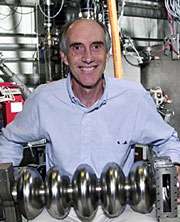
Image: Gwyn Williams holding an accelerator component inside JLab's FEL.
Terahertz light is a little-studied realm of the electromagnetic spectrum between microwave and infrared light. Also known as t-rays, terahertz light has a wavelength between 3 millimeters and .003 millimeters; and though just about everything in the universe emits them, humans can neither see nor feel these ubiquitous t-rays.
FEL Basic Research Program Manager Gwyn Williams says scientists are excited about t-rays because they can penetrate many forms of matter and are non-ionizing (don't harm living tissue at modest powers). That means they may provide medical images that are better and safer than x-rays, such as a scanner that can instantly diagnose skin cancer. They could also be used for non-invasive airport screening, spotting weapons concealed in clothing.
Built with JLab's expertise in SRF technology, the FEL is the world's most powerful tunable laser. As electrons used to create the laser beam are steered from the linear accelerator around a curve to a wiggler where the laser beam is produced, the electrons give off t-rays. These t-rays can then be routed into a lab for research. “Every time there's an electron beam, we get terahertz,” Williams says. The project is funded by the U.S. Army Night Vision and Electronic Sensors Directorate.
Terahertz research can also extend JLab's mission of studying the structure of matter. For instance, Williams says t-rays can cause individual proteins to vibrate at specific frequencies, revealing structure. “It's also fundamental physics. But instead of looking at the atomic nucleus, we're looking at how materials work at the atomic level.”
Source: DOE Pulse


