Astronomy’s Case of the Missing Disks
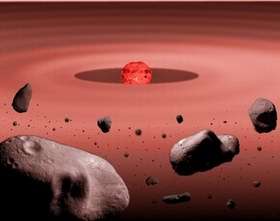
Astronomers announced Jan. 10 that they have a lead in the case of the missing disks. The report was presented by UCLA graduate student and Ph.D. candidate Peter Plavchan; his adviser, Michael Jura; and Sarah Lipscy, now at Ball Aerospace, to the American Astronomical Society meeting in San Diego. This lead may account for the missing evidence of red dwarfs forming planetary systems.
Image: Illustration of a debris disk surrounding a young red dwarf star. The stellar wind from the red dwarf star removes the dust in the debris disk by causing the dust to slowly spiral into the star. (UCLA)
The evidence
Red dwarfs (or M Dwarfs) are stars like our Sun in many respects but smaller, less massive and fainter. Approximately 70 percent of all the stars in our galaxy are red dwarfs.
"We would like to understand whether these stars form planets, as the other stars in our galaxy do," said Plavchan, who leads this research investigation.
Approximately half of all newborn stars are known to possess the materials to make planets. When stars are born, the leftover materials form what astronomers refer to as a primordial disk surrounding the star. From this primordial disk, composed of gas and small grains of solid material astronomers call "dust," planets can start to grow. As these "planetesimals" grow by accreting nearby material in the primordial disk, they also collide with one another. These collisions are frequent and violent, producing more dust forming a new disk of debris after the star is about 5–10 million years old. In our own solar system, we see evidence everywhere of these violent collisions that took place more than 4 billion years ago — such as the craters on the moon.
The debris disk of "dust" left over from these ancient collisions in our own solar system has long since dissipated. Astronomers, however, have discovered many young stars in the local part of our galaxy where these debris disks still can be seen. These stars are caught in the act of forming planets and are of great interest to astronomers who want to understand how this process works. Curiously though, only two of these stars with debris disks were found to be red dwarfs: AU Microscopium (AU Mic) and GJ 182, located 32.4 light-years and approximately 85 light‑years from Earth, respectively.
Despite red dwarfs holding a solid majority among the different kinds of stars in our galaxy, only two have been found with evidence of debris disks. If half of all red dwarfs started with the material to form planets, what happened to the rest of them? Where did the material and dust surrounding these stars go? Factors such as the ages, smaller sizes and faintness of red dwarfs do not fully account for these missing disks.
The investigation
In December 2002 and April 2003, Plavchan, Jura and Lipscy observed a sample of nine nearby red dwarfs with the Long Wavelength Spectrometer, an infrared camera on the 10-meter telescope at the Keck Observatory on Mauna Kea, Hawaii. These nine stars all are located within 100 light-years of Earth and were thought potentially to possess debris disks. None, however, showed any evidence for the presence of warm dust produced by the collisions of forming planets.
Backed by the previous research investigations that also came up empty-handed, the researchers considered what makes red dwarfs different from other bigger, brighter stars that have been found with debris disks.
"We have to consider how the dust in these young red dwarfs gets removed and where it goes," said Jura, Plavchan's thesis adviser.
In other young, more massive stars — A-, F- and G-types — the dust primarily is removed by Poynting-Robertson drag, radiative blowout and collisions.
"These first two processes are simply ineffective for red dwarfs, so something else must be going on to explain the disappearance of the debris disks," Plavchan said.
Under Poynting‑Robertson drag, a consequence of special relativity, the dust slowly spirals in towards the star until it heats up and sublimates.
The new lead in the case
Plavchan, Jura and Lipscy have discovered that there is another process similar to Poynting-Robertson drag that potentially can solve the case of the missing red dwarf debris disks: stellar wind drag.
Stars like our Sun and red dwarfs possess a stellar wind — protons and other particles that are driven by the magnetic fields in the outer layers of a star to speeds in excess of a few hundred miles per second and expelled out into space. In our own solar system, the solar wind is responsible for shaping comets' tails and producing the Aurorae Borealis on Earth.
This stellar wind also can produce a drag on dust grains surrounding a star. Astronomers have long known about this drag force, but it is less important than Poynting-Robertson drag for our own Sun. Red dwarfs, however, experience stronger magnetic storms and consequently have stronger stellar winds. Furthermore, X-ray data show that the red dwarf winds are even stronger when the stars are very young and planets are forming.
"Stellar wind drag can 'erase' the evidence of forming planets around red dwarfs by removing the dust that is produced in the collisions that are taking place. Without stellar wind drag, the debris disk would still be there and we would be able to see it with current technology," Plavchan said.
This research potentially solves the case of the missing disks, but more work is needed. Astronomers know little about the strength of stellar winds around young stars and red dwarfs. While further observations of red dwarfs by the Spitzer Infrared Telescope Facility have supported this research, this case will not be closed until we can directly measure the strength of stellar winds around young red dwarfs.
This research has been submitted to The Astrophysical Journal for publication and is supported by funding from NASA.
Source: UCLA


