Sights and Sounds of Titan
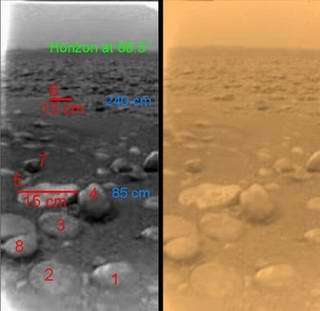
January 17, 2005 Small "rocks," possibly made of water ice...

by Dr. Tony Phillips

The European Space Agency's (ESA's) Huygens probe, carried to Saturn by the Cassini spacecraft, parachuted to the surface of Saturn's giant moon Titan on Friday, Jan. 14th, revealing finally what lies beneath Titan's thick orange clouds.
First images released by the ESA depict sinuous drainage channels leading to an apparent shoreline. What's draining? Possibly liquid methane. The orange landscape around the Huygens landing site is littered with little rocks, rounded and smooth like river-rocks on Earth. One of the images seems to show tendrils of ground fog made not of water but perhaps ethane or methane.

Image: Small "rocks," possibly made of water ice, at the Huygens landing site. Evidence of erosion at the base of these objects suggests fluvial activity. The right panel shows, approximately, the true color of the scene.

It's all a bit familiar, yet at the same time utterly alien. Researchers are elated.

Because Titan has a thick atmosphere, able to carry sound waves, the moon is a noisy place. Microphones onboard Huygens recorded the sound of wind rushing by the probe as it descended. The ESA has released about one minute's worth of the recording; it's a sample of what a traveler riding with Huygens would have heard during the descent: click here to listen.

Huygens was designed to float in case it landed in a river or lake--but it didn't. After descending by parachute for two and a half hours, the saucer-shaped probe hit solid ground at a speed of 4.5 meters per second (10 mph), experiencing a brief jolting deceleration of 15 Gs. Huygens survived the impact and continued transmitting data for more than one hour after landing.

Among the measurements sent back to Earth were air temperature, pressure, composition and wind speed sampled at points ranging from the top of Titan's atmosphere to the ground. The temperature of the landing site itself was minus 291 degrees F. A "penetrometer" on the bottom of the probe poked into the ground. The soil, it found, has the consistency of wet sand or clay and is covered by a thin crust ... of something. Scientists are still analyzing all these data.

Source: Science@NASA (by Dr. Tony Phillips)


print this article email this article download pdf blog this article bookmark this article     Stumble it Digg this share on Facebook retweet share on Reddit add to delicious
Rate this story - not rated yet


January 17, 2005 all stories

Comments: 0

not rated yet
  • Stumble this up

  • Digg this

  • share this

  • hide
  • Related Stories

  • Scientists present new results from Huygens probe
    created Jun 04, 2007 | popularity not rated yet | comments 0
  • Building our new view of Titan
    created Jun 01, 2007 | popularity not rated yet | comments 0
  • Ground-based observatories join forces with Venus Express
    created May 23, 2007 | popularity not rated yet | comments 0
  • Huygens’s second landing anniversary – the surprises continue
    created Jan 12, 2007 | popularity not rated yet | comments 0
  • How the world watched Huygens
    created Jul 27, 2006 | popularity not rated yet | comments 0


Other News

2 Earth-sized bodies with oxygen rich atmospheres found -- but they're stars not planets

Two Earth-sized bodies with oxygen rich atmospheres found -- but they're stars not planets

Space & Earth / Astronomy

created 12 hours ago | popularity 4.3 / 5 (15) | comments 1

(PhysOrg.com) -- Astrophysicists at the University of Warwick and Kiel University have discovered two earth sized bodies with oxygen rich atmospheres - however there is a bit of a disappointing snag for anyone ...


Greenland ice cap melting faster than ever

Greenland ice cap melting faster than ever

Space & Earth / Earth Sciences

created 12 hours ago | popularity 3.8 / 5 (18) | comments 12

Satellite observations and a state-of-the art regional atmospheric model have independently confirmed that the Greenland ice sheet is loosing mass at an accelerating rate, reports a new study in Science.


A faraway planet intrigues: Exoplanet with extremely tilted orbit raises new interest in stellar astronomy

A faraway planet intrigues: Exoplanet with extremely tilted orbit raises new interest in stellar astronomy

Space & Earth / Astronomy

created 20 hours ago | popularity 4.5 / 5 (11) | comments 5

(PhysOrg.com) -- Two teams of astronomers have found a planet outside the solar system that might be orbiting backwards compared to its star's rotation, a discovery that could shed light on how unique the ...


Record high temperatures far outpace record lows across US

Record high temperatures far outpace record lows across US (w/ Video)

Space & Earth / Earth Sciences

created 13 hours ago | popularity 2.9 / 5 (16) | comments 4

Spurred by a warming climate, daily record high temperatures occurred twice as often as record lows over the last decade across the continental United States, new research shows. The ratio of record highs ...


Research gives new insights into 4 billion year-old meteorites

Research gives new insights into 4 billion year-old meteorites

Space & Earth / Astronomy

created 10 hours ago | popularity 5 / 5 (1) | comments 0

(PhysOrg.com) -- Scientists have gained new insight into the makeup of ancient meteorites called Carbonaceous Chondrites, in research published in the October edition of the journal Earth Science and Planetary Le ...