Long-lost star catalog discovered on Roman statue
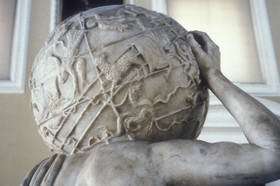
An ancient mystery may have been solved by Louisiana State University Associate Professor of Physics and Astronomy Bradley E. Schaefer.
Schaefer has discovered that the long-lost star catalog of Hipparchus, which dates back to 129 B.C., appears on a Roman statue called the Farnese Atlas. Hipparchus was one of the greatest astronomers of antiquity and his star catalog was the first in the world, as well as the most influential. The catalog was lost early in the Christian era, perhaps in the fire at the great library in Alexandria.
The Farnese Atlas is a Roman statue, dating to the second century, that depicts the Titan Atlas holding a sky globe on his shoulder. The statue, currently housed in Italy, includes relief figures on the globe depicting the ancient Greek constellations in fine detail. Schaefer has discovered that the constellation figures on the Farnese Atlas are an accurate rendition of Hipparchus' star catalog. According to Schaefer, the discovery will likely lead to the solution of several long-debated questions.
Indeed, Schaefer's discovery is already stirring interest among those in the field of astronomy.
"The constellations are one of our more enduring intellectual properties, and in antiquity, they turned the night sky into familiar territory. Dr. Schaefer's clever and disciplined analysis of the oldest graphic representation of the traditional Greek constellations reveals unexpected roots of scientific astronomy in a celebrated work of ancient art," said E.C. Krupp, director of the Griffith Observatory in Los Angeles.
Schaefer, who earned his doctorate from the Massachusetts Institute of Technology in 1983, specializes in astronomy and astrophysics. He has long been interested in the history of astronomy and has written extensively on the subject. He began his examination of the Farnese Atlas statue while conducting research on ancient constellation lore.
Schaefer said that scientists have long held Hipparchus in high regard for his work, which was conducted between 140 B.C. and 125 B.C. He is known for the discovery of the first nova and a process called precession; a theory for the motions of the sun and moon; top-quality planetary observations; and the first-ever catalog of about 1,000 stars. Unfortunately, only one of Hipparchus' books has survived to today: "Commentaries," which describes the constellation figures in detail. The rest of his written work is known only through the references of later astronomers. For example, Schaefer said, Hipparchus' star catalog was described in the work "Almagest" by the influential Greek astronomer and geographer Ptolemy, who lived around A.D. 85 to A.D. 165.
The Farnese Atlas—roughly seven feet tall and made of marble—is now in the Farnese Collection in the National Archaeological Museum in Naples, Italy. The statue's sky globe, which is 26 inches in diameter, shows 41 Greek constellations, as well as the celestial equator, tropics and ecliptic. Art historians have concluded that the statue is a late Roman copy of a Greek original. Schaefer said that the constellations are accurately depicted, so the sculptor must have based his work on some specific astronomical observations. Throughout the last century, Schaefer explained, these observations have been attributed to many sources, but not Hipparchus.
Schaefer said that a number of facts led to the conclusion that the statue's sky globe was based on Hipparchus' catalog.
Precession, as discovered by Hipparchus, is a process whereby the stars and constellation figures slowly move with respect to the celestial equator, tropics and lines of constant right ascension. This provides the key to dating the original observations, Schaefer explained, because it means that investigators need only look on the sky globe to see what date matches the constellation positions. Thus, Schaefer traveled to Naples and made the first astronomical analysis of the constellation positions.
For his analysis, Schaefer took his own pictures, because the photographic analysis requires knowledge of the distance between globe and camera. He measured a total of 70 positions on the globe and made a formal mathematical fit to find the best date. Schaefer concluded that the best date for the original observations is 125 B.C. He said that the normal margin of error in this result is ±55 years. In other words, Schaefer said, there is a two-thirds chance that the real date was somewhere between 180 B.C. and 70 B.C.
Schaefer said that the date of 125 B.C. immediately points to Hipparchus' circa-129 B.C. catalog as the original observational source. Indeed, he said, all previously proposed source candidates are confidently eliminated because they come from time periods that are either too early or too late.
Positioning on the globe is another key indicator of the source, said Schaefer. The positioning of the constellation figures on the Farnese Atlas has a typical accuracy of 3.5 degrees. Schaefer said that such accuracy is essentially impossible to achieve by simple verbal descriptions (as found in the works of other potential sources, such as Aratus or Eudoxus) which are accurate to around 8 degrees. Nevertheless, ancient star catalogs would have the required accuracy. However, it is Hipparchus who is known to have a star catalog created around the correct time, 129 B.C., whereas the next catalog, created by Ptolemy, came much too late, in A.D. 128.
In addition, Schaefer said it is known that Hipparchus constructed many sky globes based on his star catalog. For instance, ancient coins depict Hipparchus seated in front of a globe and Ptolemy writes explicitly of Hipparchus making such globes. Thus, Schaefer explained, a likely scenario is that Hipparchus used his catalog to make an accurate globe, which was later copied exactly by a Greek statue sculptor. Then, the Greek statue was later copied by a Roman sculptor.
The constellations of the Farnese Atlas also contain many specific details that point to Hipparchus as the original observer. Schaefer made a comparison between the Farnese Atlas and all ancient constellation descriptions, including those of Ptolemy and other ancient astronomers and thinkers, such as Hipparchus, Aratus, Eratosthenes, Eudoxus and Homer. All ancient sources other than Hipparchus have many and major differences in their descriptions of the constellations. However, the detailed comparison shows Hipparchus' "Commentary" to have no differences and many unique similarities.
Thus, the case for Hipparchus' lost star catalog appearing on the Farnese Atlas is based on:
- The derived date of 125 B.C., which matches Hipparchus and rejects all other candidates;
- The fact that the accuracy of the sky globe requires a star catalog, and only Hipparchus had created one before A.D. 128;
- The fact that Hipparchus is known to have produced working sky globes from his catalog;
- The fact that only Hipparchus' description of the constellation figures matches the Farnese Atlas.
Schaefer said that the discovery of Hipparchus' lost star catalog on the Farnese Atlas could provide answers to two long-standing questions that have been the source of heated debate: What did Hipparchus use as coordinates and what fraction of Hipparchus' star catalog made it into Ptolemy's "Almagest?" Now, Schaefer said, with an accurate representation of Hipparchus' catalog, researchers can make exhaustive correlations between all constellation figures on the Farnese Atlas and those contained within "Almagest." But, Schaefer said, perhaps the best part of the discovery is "simply that we have recovered one of the most famous known examples of lost ancient wisdom."
Schaefer announced his discovery at the American Astronomical Society meeting in San Diego, Calif.
Provided by Louisiana State University


