New filter promises clean water for millions
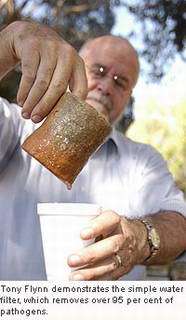
A handful of clay, yesterday’s coffee grounds and some cow manure are the simple ingredients that could bring clean drinking water to developing countries around the globe.
An innovative new technology, developed by ANU materials scientist Mr Tony Flynn, allows water filters to be made from commonly available materials and fired on the ground using manure, without the need for a kiln. The filters have been shown to remove common pathogens including E-coli. Unlike other water filtering devices, they are simple and inexpensive to make.
“They are very simple to explain and demonstrate and can be made by anyone, anywhere. They don’t require any western technology. All you need is terracotta clay, a compliant cow and a match,” said Mr Flynn.
“Everyone has a right to clean water, these filters have the potential to enable anyone in the world to drink water safely.”
The production of the filters is extremely simple. Take a handful of dry, crushed clay, mix it with a handful of organic material, such as used tea leaves, coffee grounds or rice hulls, add enough water to make a stiff biscuit-like mixture and form a cylindrical pot that has one end closed. Dry the pot in the sun, then surround them with straw, place in a mound of cow manure, light the straw and then top up the burning manure as required. In less than an hour the filters are finished.
“A potter's kiln is an expensive item and can could take up to four or five hours to heat. It needs expensive or scarce fuel, such as gas or wood, to heat it and experience to run it. With no technology, and no insulation, none of these restrictions apply.
“We are deliberately not patenting this technology in the hope that it will be used widely around the world. A simple water filter really does have the capacity to save many lives in the developing world.”
The filtration process is simple, but effective. The basic principle is that there are passages through the filter that are wide enough for water droplets to pass through, but too narrow for pathogens.
Organic materials which are combined with the clay burn away during the firing process, leaving cavities that help produce the structure in which pathogens will become trapped.
The invention was born out of a World Vision project involving the community of Manatuto in East Timor. The charity wanted to help set up a small industry manufacturing water filters, but initial research found the local clay to be too fine — a problem solved by the addition of organic material. Manure firing, with no requirement for a kiln, has made this zero technology approach available anywhere it is needed.
Tests with the deadly E-coli bacterium have seen the filters remove 96.4 to 99.8 per cent of the pathogen — well within safe levels. Using only one filter, a litre of clean water can be produced in just two hours.
Source: Australian National University


