Tutankhamun Examined in a CT Scanner
January 20, 2005 Tutankhamun Examined in a CT Scanner

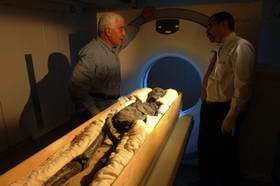
Siemens experts have been examining the mummified remains of the pharaoh Tutankhamun in a CT scanner - with unprecedented precision. Together with the Egyptian chief archaeologist, Dr. Zahi Hawass, they want to determine the cause of Tutankhamun’s death more than 3,000 years ago. It was the first time since the mummy’s discovery in 1922 that it had been removed from its resting place in the Valley of the Kings near Luxor. In 1968 the first X-ray analysis of the head revealed that the pharaoh might have died as a result of a severe blow.

The Siemens experts in Egypt report that the analysis of the mummy proved very difficult. A living patient can assume different bodily postures, but that’s of course impossible for the fragile mummy. The condition of the mummy is very bad: It was supposedly damaged when its discoverers removed jewelry from the body. In its wooden box, the body was taken to a specially outfitted truck equipped with a Somatom Emotion 6 CT scanner which is a donation from Siemens and the National Geographic Society.

The scanner, which is also used in clinical practice, contains special software that reduces the radiation dose as low as possible to avoid further damage to the mummy. In addition, the experts and technicians wore surgical masks and gloves to protect the mummy. Including preparations, the process lasted about two and one-half hours, though the scan itself took only five minutes. Overall, 1.700 images have been taken. The images of the skull have a resolution of 0.5 millimeters, while the resolution of the rest of the body is one millimeter. The experts are now evaluating the images, and the initial results are expected by the end of January.

In addition to Tutankhamun, the scientists examined many other mummies from the Valley of the Kings. Some of them had to be scanned with death masks or in wrappings, which might cover previously undiscovered jewelry. This and the resin used during mummification may lower the quality of the images. A mummy previously thought to be that of a female turned out to actually be the remains of a man. Another unexpected discovery: A mummy thought to be the body of a 70-year-old man turned out to be the mummy of a boy who was about seven years old at the time of his death. The Siemens experts expect surprises from Tutankhamun also.


print this article email this article download pdf blog this article bookmark this article     Stumble it Digg this share on Facebook retweet share on Reddit add to delicious
Rate this story - 3.2 /5 (17 votes)


January 20, 2005 all stories

Comments: 0

3.2 /5 (17 votes)
  • Stumble this up

  • Digg this

  • share this

  • hide
  • Related Stories

  • TB the culprit in the great mummy whodunnit
    created Sep 30, 2009 | popularity not rated yet | comments 0
  • How chemistry can reveal the secrets of ancient worlds
    created Jun 30, 2009 | popularity not rated yet | comments 0
  • Egypt unveils pharaonic 'brain drain' bed
    created Mar 19, 2009 | popularity not rated yet | comments 0
  • Oetzi's last days: Glacier man may have been attacked twice
    created Jan 28, 2009 | popularity not rated yet | comments 0
  • Ancient mummy has no modern children, says 'Iceman' study
    created Oct 30, 2008 | popularity not rated yet | comments 0


Other News

Research shows avatars can negatively affect users

Other Sciences / Social Sciences

created 8 hours ago | popularity 5 / 5 (1) | comments 0

(PhysOrg.com) -- Although often seen as an inconsequential feature of digital technologies, one's self-representation, or avatar, in a virtual environment can affect the user's thoughts, according to research by a University ...


New fossil plant discovery links Patagonia to New Guinea in a warmer past

New fossil plant discovery links Patagonia to New Guinea in a warmer past

Other Sciences / Archaeology & Fossils

created 9 hours ago | popularity not rated yet | comments 0

Fossil plants are windows to the past, providing us with clues as to what our planet looked like millions of years ago. Not only do fossils tell us which species were present before human-recorded history, ...


Golden State: Yes, No or Maybe?

Golden State: Yes, No or Maybe?

Other Sciences / Other

created 7 hours ago | popularity 3 / 5 (1) | comments 0

(PhysOrg.com) -- Dan Schnur, director of the College's Jesse M. Unruh Institute of Politics, analyzes the findings from the first of six USC College of Letters, Arts & Sciences/Los Angeles Times statewide ...


School textbooks have political purpose, finds study

School textbooks have political purpose, finds study

Other Sciences / Social Sciences

created 8 hours ago | popularity 2 / 5 (2) | comments 0

(PhysOrg.com) -- The simple school textbook is used by states to mould loyal citizens, according to a new study.


Gender-based pay gaps among US faculty

Other Sciences / Social Sciences

created 14 hours ago | popularity 1 / 5 (1) | comments 0

Before the Equal Pay Act of 1963 was signed into law by President Kennedy, women earned about fifty percent less than men. Nationally, women still earn an average of thirty percent less than men regardless of education, choice ...