DNA molecules used to assemble nanoparticles
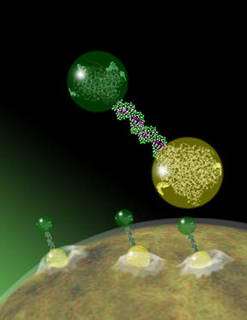
University of Michigan researchers have developed a faster, more efficient way to produce a wide variety of nanoparticle drug delivery systems, using DNA molecules to bind the particles together.
Nanometer-scaled dendrimers can be assembled in many configurations by using attached lengths of single-stranded DNA molecules, which naturally bind to other DNA strands in a highly specific fashion.
Image: Dendrimer complex docking on cellular folate receptors (Michigan Center for Biologic Nanotechnology)
"With this approach, you can target a wide variety of molecules---drugs, contrast agents---to almost any cell," said Dr. James R. Baker Jr., the Ruth Dow Doan Professor of Nanotechnology and director of the Center for Biologic Nanotechnology at U-M.
Nanoparticle complexes can be specifically targeted to cancer cells and are small enough to enter a diseased cell, either killing it from within or sending out a signal to identify it. But making the particles is notoriously difficult and time-consuming.
The nanoparticle system used by Baker's lab is based on dendrimers, star-like synthetic polymers that can carry a vast array of molecules on the ends of their arms. It is possible to build a single dendrimer carrying many different kinds of molecules such as contrast agents and drugs, but the synthesis process is long and difficult, requiring months for each new molecule added to the dendrimer in sequential steps. And the yield of useful particles drops with each successive step of synthesis.
For a paper published Jan. 21 in the journal Chemistry and Biology, U-M Biomedical Engineering graduate student Youngseon Choi built nanoparticle clusters of two different functional dendrimers, one designed for imaging and the other for targeting cancer cells. Each of the dendrimers also carried a single-stranded, non-coding DNA synthesized by Choi.
In a solution of two different kinds of single dendrimers, these dangling lengths of DNA, typically 34-66 bases long, found complementary sequences on other dendrimers and knitted together, forming barbell shaped two-dendrimer complexes with folate on one end and fluorescence on the other end.
Folate receptors are over-expressed on the surface of cancer cells, so these dendrimer clusters would tend to flock to the diseased cells. The other end of the complex carries a fluorescent protein so that the researchers can track their movement.
A series of experiments using cell sorters, 3-D microscopes and other tools verified that these dendrimers hit their targets, were admitted into the cells and gave off their signaling light. The self-assembled dendrimer clusters were shown to be well formed and functional.
"This is the proof-of-concept experiment," Choi said. But now that the assembly system has been worked out, other forms of dendrimer clusters are in the works.
"If you wanted to make a therapeutic that targeted five drugs to five different cells, it would be 25 synthesis steps the traditional way," Baker said. At two to three months per synthesis, and a significant loss of yield for each step, that approach just wouldn't be practical.
Instead, the Baker group will create a library of single-functional dendrimers that can be synthesized in parallel, rather than sequentially, and then linked together in many different combinations with the DNA strands.
"So it's like having a shelf full of Tinker Toys," Baker said.
An array of single-functional dendrimers, such as targets, drugs, and contrast agents, and the ability to link them together quickly and easily in many different ways would enable a clinic to offer 25 different "flavors" of dendrimer with only ten synthesis steps, Baker said.
Baker foresees a nanoparticle cluster in which a single dendrimer carries three single-strands of DNA, each with a sequence specific to the DNA attached to other kinds of dendrimers. Put into solution with these other tinker toys, the molecule would self-assemble into a four-dendrimer complex carrying one drug, one target, and one fluorescent.
Source: University of Michigan


