Einstein’s brain
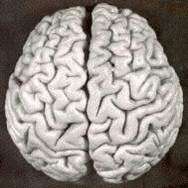
During his life, Albert Einstein made some of the world’s greatest scientific discoveries. However, the location of his brain, which was controversially removed by the pathologist Dr Thomas Harvey upon Einstein’s death in 1955, remained a mystery for years. A new TV series, co-presented by UCL’s Dr Mark Lythgoe and physicist Dr Jim Al-Khalili, uncovers the odyssey of Einstein’s brain in order to understand whether a person’s brain, even after death, can reveal the truth behind their genius.
Image: Einstein’s brain (©Thomas Harvey/Icon Films)
During the series, Dr Lythgoe profiles the individuals involved in the bizarre life after death journey of Einstein’s brain, including Dr Thomas Harvey, the pathologist who removed and dissected Einstein’s brain and Mr Steven Levy, a journalist who eventually rediscovered the brain in a cider box in Dr Harvey’s living room in Wichita, Kansas.
Months before his death, Einstein wrote to his biographer, Carl Seelig, expressing the idea that he wanted to donate his body to science. However, he failed to leave any explicit instructions, and the removal of his brain was Dr Harvey’s idea. He said: “I just knew we had permission to do an autopsy and I assumed that we were going to study the brain.” Einstein’s family only learned about the brain’s removal upon reading a report in the New York Times the following day. Even Otto Nathan, Einstein’s friend and executor of his estate, failed to realise what was happening, despite witnessing the autopsy.
After the removal of the brain, Dr Harvey cut it into 240 fine sections and embedded it in celodin to allow for microscopic examination. After the discovery of parts of the brain in a cider box in Dr Harvey’s living room in 1996 by Steven Levy, the remaining pieces of the brain were presented to Dr Elliot Krauss, chief pathologist at Princeton Hospital.
For the first time since Einstein’s death, Dr Lythgoe has reconstructed the brain as it would have looked when it was removed in 1955. Using photographs taken by Dr Harvey after it was removed, and a state-of-the-art computer controlled laser-modelling process known as stereolithography, he has created a micron-accurate, life-sized model of the brain. Dr Lythgoe said: “When I examined it, I felt as if I had climbed to the top of a mountain and enjoyed a view – one of intellectual creativity – that has never been seen before.”
Einstein’s brain weighed only 1,230 grams, less than the average adult brain which weighs about 1,400 grams. However, the density of neurons was greater. Dr Lythgoe said: “Normally the parietal cortex is divided by a deep groove, but his was absent in Einstein’s brain, merging two remote regions and increasing connectivity in this area. Recent studies have linked this area with mathematical skills and those around it with visuospatial processing, and now we know that this anatomical feature makes sense.”
2005 marks the centenary of the publication of Einstein’s groundbreaking articles on special relativity, Brownian motion and the photoelectric effect, which appeared in a leading German physics journal. Despite failing to get a job at a university, Einstein made his discoveries in his spare time while working in the Swiss Patent office, and was subsequently awarded the Nobel Prize for physics in 1921 for his work on the photoelectric effect.
Dr Lythgoe said: “Despite the best efforts of scientists and philosophers, nobody has yet explained the true nature of genius in the human mind, or the secret of Einstein’s astonishing scientific creativity.”
Source: University College London


