MetaChip provides quick, efficient toxicity screening of potential drugs
Researchers at the University of California, Berkeley, and Rensselaer Polytechnic Institute have created a biotech chip that mimics the metabolic reactions in the human liver, allowing rapid screening of potential drugs to identify those activated by the liver and to weed out those made toxic.
"The MetaChip would allow testing a backlog of compounds for toxicity earlier in the drug discovery process – faster and more efficiently – and help remove a current bottleneck in the drug discovery process," said Douglas S. Clark, professor of chemical engineering at UC Berkeley.
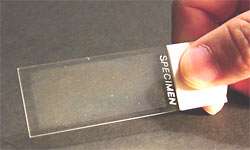
Image: The MetaChip, developed by Douglas Clark and Jonathan Dordick, can do rapid toxicity testing of potential drug candidates. (Photo courtesy Clark and Dordick)
The MetaChip, short for metabolizing enzyme toxicology assay chip, was developed by Clark and colleague Jonathan S. Dordick, the Howard P. Isermann '42 Professor of Chemical and Biological Engineering at Rensselaer. The chip used in the current study was produced by the biotech company Solidus Biosciences, Inc., a startup they founded in Troy, New York, with funding assistance from the National Institutes of Health.
"The MetaChip offers a new approach in the identification of pharmacologically safe and effective lead drug compounds for advancement to the preclinical phase of drug development," said Dordick. "The research results thus far indicate that this technique could be incorporated into an effective process for toxicity analysis at early stages in drug discovery."
The liver is the body's detox station, degrading chemicals and often, in the case of drugs, activating them to become effective elsewhere in the body. Clark and Dordick took several of the liver's major detoxification enzymes, called cytochrome P450 enzymes, and put them on a chip in order to create liver metabolites of drug candidates and rapidly test them for toxicity against specific types of cells.
"Many compounds taken as drugs are not active until they are metabolized by enzymes in the liver," Clark explained. "The MetaChip products correspond to those generated in the liver, but then they can be screened against many different cell types.”
In their new study, Clark and Dordick tested liver metabolites against breast cancer cells as a model system to find metabolites that damage or kill the cells.
The study was published this week by Clark, Dordick and their colleagues in the Online Early Edition of the Proceedings of the National Academy of Sciences. The paper will be printed in the Jan. 25 issue.
Development of the MetaChip is part of a collaborative research project funded by the NIH to find more efficient ways to synthesize and identify compounds that merit further development as possible new drugs. According to Clark, while drug companies have found rapid means of generating new drug candidates, they have yet to come up with a way to rapidly screen these candidates for toxicity.
"There are high-throughput methods of generating new compounds, but few if any high-throughput methods for toxicity analysis, forcing chemists to select compounds for drug development based on limited information about their toxicological properties," he said. "This technology fills that gap. It enables basic human metabolism to be carried out on a chip and the products of that metabolism can be screened for toxicity using the same chip platform."
Current tox screening involves cultured liver cells and even slivers of liver, but these tend to give inconsistent results and contain low levels of the P450 enzymes responsible for the initial clearance of drugs from the body and the activation of prodrugs, the researchers said. P450 enzymes are iron-containing proteins that oxidize chemicals, often making them more water-soluble so that potentially harmful substances can be eliminated more easily from the body. The antihistamine loratidine (Claritin) is one example of a prodrug that must be activated by liver enzymes to be effective, the researchers pointed out in their paper. On the other hand, the common pain reliever acetaminophen (Tylenol) is converted by the liver into a toxic chemical that can damage the liver.
The MetaChip contains recombinant P450 enzymes encapsulated in a sol-gel that immobilizes them on a glass slide, so that many drug candidates can be tested simultaneously. The team plans to merge the current MetaChip with a complementary chip on which live cells are growing to enable seamless testing of the drug metabolites against an array of different cell types from the body. This will identify organ-specific drug toxicity and possible adverse drug interactions.
"Our research will expand to include other cell types, compounds, and human enzymes responsible for drug metabolism, including the cytochrome P450s," Clark said. "The outcome of this work may facilitate the elimination of toxic drug candidates much earlier in the drug development process, thereby allowing research efforts to concentrate on more promising and less toxic candidates."
The research is led jointly by Dordick and Clark, with Moo-Yeal Lee, post-doctoral research associate at Rensselaer, and Chan Beum Park, now assistant professor of chemical and materials engineering at Arizona State University. The work was supported by the NIH.
Source: UC Berkeley


