53-keys New Standard Keyboard
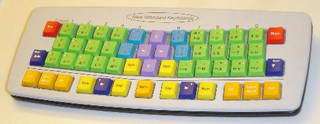
After 130 years of typing the same way the keyboard has finally grown up. New Standard Keyboards of Santa Maria, California announced "alphabetical" keyboard that offers user-friendly benefits and quick data entry for any level user. New Standard Keyboards debuted a patented USB-interface computer keyboard at CES 2005. This keyboard has just 53-keys and offers many advances over QWERTY and DVORAK designs.
The New Standard Keyboard is a bold departure from current designs and will compete directly with standard QWERTY models as a replacement keyboard for users who value user-friendliness over arbitrary standardization. The keyboard has only 53 keys instead of 101 or more, which places them all within easy reach of the home position. It also takes up much less desk space, measuring just 12.5-inches wide x 5 inches deep x 1-inch thick.
Still Driving a “Horse-Drawn” Computer?
The New Standard Keyboard solves all the problems associated with QWERTY, which was used on the first commercially produced typewriter in 1873. Ironically, QWERTY was actually designed to slow down the typist to prevent jamming the keys, and we’ve been stuck with that layout since. While QWERTY was great in its day, it’s not relevant on a computer. Computer keys can be placed in any order desired. After 130 years most people still use a keyboard layout specifically designed to be as inefficient as possible. New Standard Keyboards is changing that.
Many have attempted to build a better keyboard. The Dvorak keyboard of the 1930's is the most famous. It never caught on because the demand was for user-friendliness (it still is). People want instant gratification. Dvorak’s jumbled letters look no better than QWERTY, and no-one wants to buy anything that has a significant learning curve just to reach a low level of hunt and peck! Dvorak also overlooked ergonomics and his design retained the crippling key layout that forces the left wrist into a grossly unnatural position.
Those who value user-friendliness over standardization and demand attention to ergonomics will love the New Standard Keyboard…
A Keyboard Designed for Any User
This 53-key alphabetical-oriented keyboard with USB support for IBM-compatible systems is a long–awaited solution to the QWERTY keyboard problem, which has confounded typists for 130 years, according to New Standard Keyboards.
The keyboard is the invention of John Parkinson, an electrical engineer who also holds a degree in psychology with an emphasis on industrial psychology and ergonomics. Parkinson set up training programs in a typewriter factory prior to branching off to develop the New Standard Keyboard, which has earned patents in the USA and UK.
The keys are arranged alphabetically so there is no learning curve for hunt and peck typists as well as senior citizens who have never had a computer because they are challenged by the difficult basic keyboard. The keyboard can be learned at a glance, and differs from other manufacturers attempts at alphabetical-based designs because it is also efficient for high speed typing.
The New Standard Keyboard has several functional and ergonomic advantages over QWERTY keyboards, which Parkinson believes will make it a desired accessory for new system buyers and those wishing to upgrade or update their keyboard.
The advantages include: the alignment of the keys with natural movements of fingers to insure proper posture while typing; alphabetical letters can be easily found and keys are color-coded; all keys can be easily reached from the home position; shift keys are centralized and shift characters can be easily typed one-handed; editing keys are integrated; the keyboard has a smaller footprint, which allows the mouse to be placed right next to the typing keys; and there are only half as many keys to learn.
The New Standard Keyboard also eliminates the “typing on concrete” feel experienced on many laptops and the “mushy” feel of some desktop keyboards. Parkinson’s design uses a new, short-travel key (2mm) that has its snap point very early in the travel distance to produce a positive click action with minimal finger movement while still providing a softer feel.
The New Standard Keyboard will be sold to distributors and resellers and has a suggested retail price of $69.95. It is compatible with all systems running Microsoft Windows 95 and above. It will ship in April 2005.


