SMART-1's first images from the Moon
January 26, 2005
ESA's SMART-1 captured its first close-range images of the Moon this January, during a sequence of test lunar observations from an altitude between 1000 and 5000 kilometres above the lunar surface.
SMART-1 entered its first orbit around the Moon on 15 November 2004. It has spent the two months following spiralling down to the Moon and testing its array of instruments.
The first four days after being captured by the lunar gravity were very critical. There had been the risk, being in an 'unstable' trajectory, of escaping the Moon's orbit or crashing onto the surface. Because of this, the electric propulsion system (or 'ion engine') started a thrust to stabilise the capture.
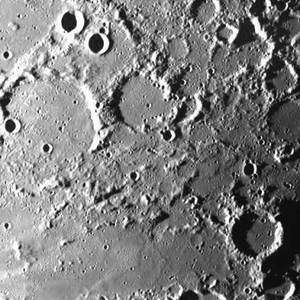
Image: This image was taken by the AMIE instrument (clear filter) on SMART-1 on 29 December 2004. This image shows an area of the Moon featuring the Mouchez crater near to lunar zero longitude. Credits: ESA/Space-X, Space Exploration Institute
The ion engine was switched on until 29 December, allowing SMART-1 to make ever-decreasing loops around the Moon. The engine was switched off between 29 December and 3 January 2005 to allow scientists to start observations. At this point, the AMIE camera took the close-up lunar images. The engine was switched off again to optimise fuel consumption on 12 January, and SMART-1 will spend until 9 February making a medium resolution survey of the Moon, taking advantage of the favourable illumination conditions.
ESA's SMART-1 Project Scientist Bernard Foing said "A sequence of test lunar observations was done in January at distances between 1000 and 5000 kilometres altitude, when the electric propulsion was paused. We are conducting more survey test observations until the electric propulsion resumes from 9 February to spiral down further towards the Moon. SMART-1 will arrive on 28 February at the initial orbit with altitudes between 300 and 3000 kilometres to perform the first phase of nominal science observations for five months."
The first close-up image shows an area at lunar latitude 75° North with impact craters of different sizes. The largest crater shown here, in the middle left of the image, is Brianchon. The second largest, at the bottom of the image, is called Pascal.
At low illumination angles, the crater shadows allow scientists to derive the height of crater rims.
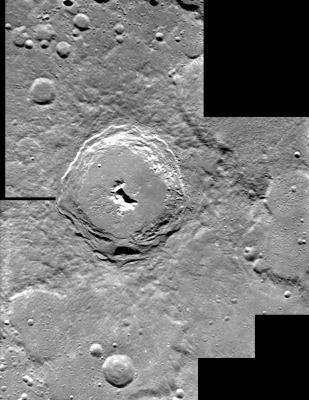
The mosaic of images covers the 120 kilometre diameter Pythagoras complex impact crater. The central peak corresponds to the rebound of the subsurface crust during the violent impact, and its mineralogical mapping will give information on the vertical variations of the crust composition.
"This image was the first proof that the AMIE camera is still working well in lunar orbit," says AMIE Principal Investigator Jean-Luc Josset of Space-X.
The composite images shown here were created to show larger-scale features. The first mosaic shows the complex impact crater Pythagoras and the strip of images (bottom) was produced from images taken consecutively along one orbit.
Starting with this mosaic, SMART-1 scientists expect to build up a global medium-resolution context map, where high-resolution images later observed from lower altitude can be integrated.
Source: ESA
-
China unveils high resolution global moon map
5 hours ago |
4.5 / 5 (4) |
0
-
GRAIL returns first video from moon's far side
Feb 01, 2012 |
4.6 / 5 (13) |
3
-
Russia opens talks with NASA and ESA with plans for manned lunar base
Jan 25, 2012 |
5 / 5 (15) |
16
-
Photo industry mourns Kodak
Jan 20, 2012 |
not rated yet |
0
-
LRO lets you stand on the rim of Aristarchus crater
Dec 30, 2011 |
5 / 5 (5) |
3
-
Engineers build first sub-10-nm carbon nanotube transistor
Feb 01, 2012 |
4.9 / 5 (31) |
30
-
Something old, something new: Evolution and the structural divergence of duplicate genes
Jan 31, 2012 |
4.6 / 5 (7) |
1
-
The hidden nanoworld of ice crystals: Revealing the dynamic behavior of quasi-liquid layers
Jan 30, 2012 |
5 / 5 (3) |
1
-
Stock market network reveals investor clustering
Jan 27, 2012 |
3.9 / 5 (23) |
8
-
Of microchemistry and molecules: Electronic microfluidic device synthesizes biocompatible probes
Jan 26, 2012 |
5 / 5 (1) |
0
More news stories
Europe stakes billion-dollar bet on new rocket
A pencil-slim rocket is scheduled to lift into space from South America on Monday, carrying a billion-dollar bet that Europe can grab a juicy slice of the market to place satellites in low orbit.
Space & Earth / Space Exploration
2 hours ago |
3.5 / 5 (2) |
0
NASA sees wide-eyed cyclone Jasmine
Cyclone Jasmine's eye has opened wider on NASA satellite imagery, as it moves through the Southern Pacific Ocean.
Space & Earth / Earth Sciences
18 hours ago |
3.5 / 5 (2) |
2
NASA sees Giovanna reach cyclone strength, threaten Madagascar
Tropical Storm 12S built up steam and became a cyclone on February 10, 2012 as NASA's Terra satellite passed overhead. Residents of east-central Madagascar should prepare for this cyclone to make landfall ...
Space & Earth / Earth Sciences
18 hours ago |
not rated yet |
0
Political leaders play key role in how worried Americans are by climate change: study
More than extreme weather events and the work of scientists, it is national political leaders who influence how much Americans worry about the threat of climate change, new research finds.
Feb 06, 2012 |
5 / 5 (6) |
68
Humans may have helped the decline of African rainforests 3000 years ago
(PhysOrg.com) -- Large areas of rainforests in Central Africa mysteriously disappeared over three thousand years ago, to be replaced by savannas. The prevailing theory has been that the cause was a change ...
Walney offshore wind farm is world's biggest (for now)
(PhysOrg.com) -- The Walney wind farm on the Irish Sea--characterized by high tides, waves and windy weather--officially opened this week. The farm is treated in the press as a very big deal as the Walney ...
GPS court ruling leaves US phone tracking unclear
A US Supreme Court decision requiring a warrant to place a GPS device on the car of a criminal suspect leaves unresolved the bigger issue of police tracking using mobile phones, legal experts say.
Anonymous briefly knocks CIA website offline (Update 2)
The website of the Central Intelligence Agency was briefly inaccessible on Friday after the hacker group Anonymous claimed to have knocked it offline.
Study finds that anti-diabetic medication can prevent the long-term effects of maternal obesity
In a study to be presented today at the Society for Maternal-Fetal Medicine's annual meeting, The Pregnancy Meeting, in Dallas, Texas, researchers will report findings that show that short therapy with the anti-diabetic medication ...
Netflix settlement trims 14 pct off 4Q earnings
(AP) -- Netflix pressed the rewind button on its fourth-quarter earnings after settling allegations that the video subscription service violated a consumer-privacy law.
Employers feel no love for unscrupulous practice of 'service sweethearting'
A new study led by two Florida State University marketing professors finds that some frontline service employees who are rewarded for hikes in customer loyalty and satisfaction also may engage in "service ...