Laser applications heat up for carbon nanotubes
January 26, 2005 Laser applications heat up for carbon nanotubes

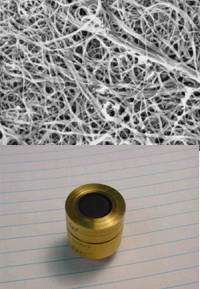
Carbon nanotubes (top) are applied to a NIST-developed pyroelectric detector (bottom) that may improve thermal conductivity and resistance to laser damage. Credit: NIST

Carbon nanotubes -- a hot nanotechnology with many potential uses -- may find one of its quickest applications in the next generation of standards for optical power measurements, which are essential for laser systems used in manufacturing, medicine, communications, lithography, space-based sensors and other technologies.

As described in a forthcoming paper in Applied Optics, scientists at the National Institute of Standards and Technology (NIST) and the National Renewable Energy Laboratory have made prototype pyroelectric detectors coated with carbon nanotubes. Pyroelectric detectors and other thermal detectors are the basis for all primary standards used to ensure that laser power and energy measurements are traceable to fundamental units.

The coating absorbs laser light and converts it to heat, which is conducted to a detector underneath made of pyroelectric material. The detector's rise in temperature generates a current, which is measured to determine the power of the laser.

Carbon nanotubes---tiny cylinders made of carbon atoms---conduct heat hundreds of times better than today's detector coating materials. Nanotubes are also resistant to laser damage and, because of their texture and crystal properties, absorb light efficiently. Scientists hope that the nanotubes' resistance to aging and hardening will allow them to extend the range of NIST laser power standards to ultraviolet wavelengths, which would support the development and calibration of sensors for detecting chemical and biological weapons. The research also may contribute to the use of carbon nanotubes in fuel cells.

As described in the paper, the NIST-led research team was first to demonstrate the use of an airbrush technique to apply carbon nanotubes to a thermal detector. The team also will report, at a workshop on carbon nanotubes at NIST Jan. 26-28, growing multiwalled nanotubes directly on detectors with a chemical vapor deposition process. The team is now measuring the optical and thermal properties of various tube compositions and topologies, using an unusual approach that is much faster than conventional methods.

Publication: J.H. Lehman, C. Engtrakul, T. Gennett, and A.C. Dillon. 2005. Single-wall carbon nanotube coating on a pyroelectric detector. Applied Optics, Vol. 44. Slated at press time for Feb. 1.

Source: NIST


print this article email this article download pdf blog this article bookmark this article     Stumble it Digg this share on Facebook retweet share on Reddit add to delicious
Rate this story - not rated yet


January 26, 2005 all stories

Comments: 0

not rated yet
  • Stumble this up

  • Digg this

  • share this

  • hide
  • Related Stories

  • Nanoparticles Detect and Purge Metastases in Lymph Nodes
    created Oct 30, 2009 | popularity not rated yet | comments 0
  • Next-generation microcapsules deliver 'chemicals on demand'
    created Oct 28, 2009 | popularity not rated yet | comments 0
  • Race for Superconductors Shrinks to Nanoscale
    created Oct 09, 2009 | popularity not rated yet | comments 0
  • Golden Nanotubes Detect Tumor Cells, Map Sentinel Lymph Nodes
    created Sep 24, 2009 | popularity not rated yet | comments 0
  • Golden Nanotubes Used for Imaging Agent to Detect Tumor Cells, Map Sentinel Lymph Node
    created Aug 26, 2009 | popularity not rated yet | comments 0


Other News

carbon fiber

Ultra-Long Carbon Nanotubes Could Serve as Future Transmission Lines

Nanotechnology / Nanomaterials

created Nov 10, 2009 | popularity 4.8 / 5 (25) | comments 14

(PhysOrg.com) -- When it comes to carbon nanotubes, the majority of research so far has focused on small-scale applications. But now, a team of researchers from Rice University has created carbon nanotubes ...


Researchers turn algae into high-temperature hydrogen source

Researchers turn algae into high-temperature hydrogen source

Nanotechnology / Nanophysics

created Nov 12, 2009 | popularity 3.6 / 5 (7) | comments 5

In the quest to make hydrogen as a clean alternative fuel source, researchers have been stymied about how to create usable hydrogen that is clean and sustainable without relying on an intensive, high-energy ...


Argonne 'homegrown' hybrid solar cell aims for low-cost power

Argonne 'homegrown' hybrid solar cell aims for low-cost power

Nanotechnology / Nanomaterials

created Nov 10, 2009 | popularity 4.2 / 5 (11) | comments 3

(PhysOrg.com) -- Scientists at the U.S. Department of Energy’s (DOE) Argonne National Laboratory have refined a technique to manufacture solar cells by creating tubes of semiconducting material and then "growing" ...


Engineers image nanostructure of a solid acid catalyst and boost its catalytic activity

Nanotechnology / Nanomaterials

created Nov 09, 2009 | popularity 5 / 5 (3) | comments 2

The catalytic processes that facilitate the production of many chemicals and fuels could become much more environmentally friendly thanks to a breakthrough achieved by researchers from Lehigh and Rice Universities.


Scientists develop DNA origami nanoscale breadboards for carbon nanotube circuits

Scientists develop DNA origami nanoscale breadboards for carbon nanotube circuits

Nanotechnology / Nanomaterials

created Nov 10, 2009 | popularity 5 / 5 (7) | comments 0

In work that someday may lead to the development of novel types of nanoscale electronic devices, an interdisciplinary team of researchers at the California Institute of Technology has combined DNA's talent ...