Fermilab Experiment Prepares to Send Its First Neutrinos 450 miles away to Minnesota
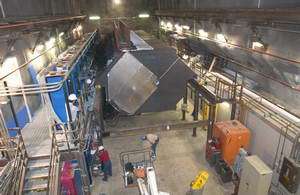
January 27, 2005 NuMI / MINOS Near Detector Construction at Fermilab

Scientists at the Department of Energy’s Fermi National Accelerator Laboratory will begin a projected five-year experiment in early February, 2005 by sending the first batches of subatomic particles called neutrinos on a path through the earth from the laboratory, about 40 miles west of Chicago, to a detector located in the historic Soudan iron mine a half-mile underground in the northeastern corner of Minnesota, about 450 miles away.

Image: NuMI / MINOS Near Detector Construction at Fermilab

Neutrinos are extremely abundant in nature - trillions of them are passing through us at any given moment. They interact with the atoms of ordinary matter so seldom that they can pass through air, water, rocks, or people without a trace. Neutrinos from cosmic rays go through the entire Earth, mysteriously morphing from one kind to another as they travel through space.

The Main Injector Neutrino Oscillation Search (the MINOS experiment) will use neutrinos produced at Fermilab’s Main Injector accelerator to probe the secrets of these elusive subatomic particles: where do they come from, what are their masses and how do they change from one kind to another? When the experiment begins operations, neutrinos in the NuMI (for “Neutrinos at the Main Injector”) beam will travel straight through the earth, from Fermilab to Soudan in 2.5 milliseconds—no tunnel needed. In Minnesota, a 6,000-ton particle detector will search for neutrinos that may have changed from one kind to another during the trip.

The 200-plus MINOS experimenters will use the change from one type of neutrino to another as the key to discovering the neutrino’s secrets. The MINOS experiment involves scientists, engineers, technical specialists and students from 32 institutions in six countries, including Brazil, France, Greece, Russia, the United Kingdom and the United States. The institutions include universities and national laboratories.

Source: Fermilab


print this article email this article download pdf blog this article bookmark this article     Stumble it Digg this share on Facebook retweet share on Reddit add to delicious
Rate this story - not rated yet


January 27, 2005 all stories

Comments: 0

not rated yet
  • Stumble this up

  • Digg this

  • share this

  • hide
  • Related Stories

  • Cosmic rays detected deep underground reveal secrets of the upper atmosphere (Video)
    created Jan 21, 2009 | popularity not rated yet | comments 0
  • Einstein's relativity survives neutrino test
    created Oct 15, 2008 | popularity not rated yet | comments 0
  • MINOS experiment sheds light on mystery of neutrino disappearance
    created Mar 30, 2006 | popularity not rated yet | comments 0
  • Underground physics: Searching for neutrinos in deep places
    created Apr 03, 2005 | popularity not rated yet | comments 0
  • Neutrino To Be Lucky Catch
    created Mar 15, 2005 | popularity not rated yet | comments 0


Other News

In the Brain, Seven Is A Magic Number

In the Brain, Seven Is A Magic Number

Physics / General Physics

created 3 hours ago | popularity 4.3 / 5 (10) | comments 2

Having a tough time recalling a phone number someone spoke a few minutes ago or forgetting items from a mental grocery list is not a sign of mental decline; in fact, it's natural.


Scientists react as they stand in front of a screen at CERN

First atoms reported smashed in Large Hadron Collider (Update)

Physics / General Physics

created 6 hours ago | popularity 4.8 / 5 (15) | comments 4

Two circulating beams on Monday produced the first particle collisions in the world's biggest atom smasher, the Large Hadron Collider (LHC), three days after its restart, scientists announced.


Visual assistance for cosmic blind spots

Visual assistance for cosmic blind spots

Physics / General Physics

created 7 hours ago | popularity 4 / 5 (2) | comments 0

A bit of imagination on the part of a measuring instrument wouldn't be a bad thing. It could help to add data from areas where the instrument is unable to measure. However, it must do so constructively. In ...


Big Bang atom smasher sends beams in 2 directions (AP)

Large Hadron Collider sends beams in 2 directions

Physics / General Physics

created 10 hours ago | popularity 4.9 / 5 (9) | comments 0

(AP) -- The world's largest atom smasher made another leap forward Monday by circulating beams of protons in opposite directions at the same time in the $10 billion machine after more than a year of repairs, ...


Straightening messy correlations with a quantum comb

Straightening messy correlations with a quantum comb

Physics / Quantum Physics

created 6 hours ago | popularity 4.7 / 5 (6) | comments 0

Quantum computing promises ultra-fast communication, computation and more powerful ways to encrypt sensitive information. But trying to use quantum states as carriers of information is an extremely delicate ...