"Buddy List" in the Car - Transmitting to Friends on the Road
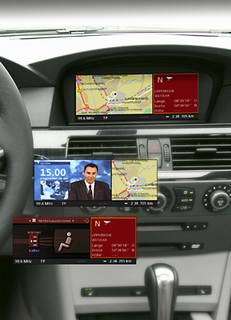
January 28, 2005 The first infotainment system based on the Top Level Architecture from Siemens VDO Automotive was introduced in 2003

In addition to making driving easier for motorists, the infotainment systems of the future will also boost traffic safety. Not far from Paris, in the city of Rambouillet, Siemens has introduced the latest trends in this field. Infotainment systems combine consumer electronics with electronic information systems and make both easier to use. Tomorrow’s motorists will view route information in video quality, and their travel directions will be displayed on their windshields. And there will be "car buddies" — drivers who will communicate with friends whose vehicles are nearby.

Developers from Siemens VDO Automotive have considered this solution, which would make it possible for drivers to arrange meetings: Just a small addition to an infotainment system’s hardware and software is all that’s needed to be able to create car buddies. Just as Internet-based messaging systems can notify users when their friends are simultaneously online, in the future it will be possible for motorists to call up the locations of their friends at any time — provided that the friends have given their permission. For the transportation professionals, a modified version of this technology is almost yesterday’s news: It’s already offered by Siemens in the form of tracking and tracing solutions for the management of freight transport fleets.

In the passenger car of the future, the borders separating the virtual and real worlds will be much less distinct. The vehicle’s navigation monitor will display details of the surrounding landscape and sightseeing attractions in nearly photo-realistic images, and an integrated camera will continually film the area in front of the car. Computers will then incorporate the route information in the video imagery recorded by the camera. To do this, the computer compares the data for the recorded objects with the road information it has stored, and then superimposes the appropriate route on the video image. Plans call for this “augmented reality” process to be integrated into a head-up display; in other words, it will be projected onto the windshield. This will make it possible for the driver to continually monitor traffic situations, and that means safer driving. The Siemens innovations used won’t be limited to route planning: A car’s central infotainment control system will provide the motorist with the latest news, and during the drive home it can even send a message to the driver’s house — telling it to turn up the heat.


print this article email this article download pdf blog this article bookmark this article     Stumble it Digg this share on Facebook retweet share on Reddit add to delicious
Rate this story - not rated yet


January 28, 2005 all stories

Comments: 0

not rated yet
  • Stumble this up

  • Digg this

  • share this

  • hide
  • Related Stories

  • Bumpy road for satellite TV in cars
    created Oct 14, 2009 | popularity not rated yet | comments 0
  • Probing Question: Where are all the cool robots?
    created Oct 01, 2009 | popularity not rated yet | comments 0
  • Medical ethics experts identify, address key issues in H1N1 pandemic
    created Sep 23, 2009 | popularity not rated yet | comments 0
  • Asking a machine to spot threats human eyes miss
    created May 10, 2009 | popularity not rated yet | comments 0
  • Auto show looking more like CES than not
    created Jan 21, 2009 | popularity not rated yet | comments 0


Other News

Researcher: Faint writing seen on Shroud of Turin (AP)

Researcher: Faint writing seen on Shroud of Turin (Update)

Other Sciences / Archaeology & Fossils

created Nov 20, 2009 | popularity 2.4 / 5 (34) | comments 52

(AP) -- A Vatican researcher has rekindled the age-old debate over the Shroud of Turin, saying that faint writing on the linen proves it was the burial cloth of Jesus. Experts say the historian may be reading ...


Living buildings could mop up carbon dioxide

Living buildings could mop up carbon dioxide

Other Sciences / Other

created 16 hours ago | popularity 1 / 5 (2) | comments 1

(PhysOrg.com) -- Architecture could help us tackle climate change, if we start to design our buildings with 'living' materials, according to Dr Rachel Armstrong, UCL Bartlett School of Architecture.


Climate change could boost incidence of civil war in Africa

Other Sciences / Social Sciences

created Nov 23, 2009 | popularity 2.4 / 5 (16) | comments 10

Climate change could increase the likelihood of civil war in sub-Saharan Africa by over 50 percent within the next two decades, according to a new study led by a team of researchers at University of California, Berkeley, ...


Explained: The Discrete Fourier Transform

Explained: The Discrete Fourier Transform

Other Sciences / Mathematics

created Nov 25, 2009 | popularity 4.1 / 5 (27) | comments 8

(PhysOrg.com) -- In 1811, Joseph Fourier, the 43-year-old prefect of the French district of Isčre, entered a competition in heat research sponsored by the French Academy of Sciences. The paper he submitted ...


Political views may skew perception of skin tone, new study finds

Other Sciences / Social Sciences

created Nov 24, 2009 | popularity 3.6 / 5 (5) | comments 7

(PhysOrg.com) -- Political affinity could influence how some people view the skin tone of biracial political candidates, according to a new study from the University of Chicago Booth School of Business, New York University ...