Spectroscopy for the Real World
New system used to analyze environmental, biological phenomena in their natural state
One good thing leads to another. A team of scientists used a first-of-its-kind spectroscopy system at the U.S. Department of Energy’s Advanced Light Source (ALS) at Lawrence Berkeley National Laboratory to obtain the first direct observations of negatively charged ions accumulating on the surfaces of salt solutions.
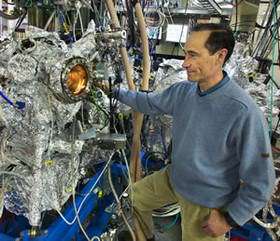
Photo: Salmeron designed the high-pressure photoelectron spectroscopy system to analyze compounds as they appear in the real world.
Their work paves the way for a better understanding of the role played by tiny airborne salt particles, emitted into the air by crashing waves and sea spray, in a slew of atmospheric and environmental processes, such as the destruction of the ozone layer.
“This is important because many atmospheric phenomena are driven by reactions with the surface of sea salt aerosols,” says Miquel Salmeron, a physicist with Berkeley Lab's Materials Sciences Division who has pioneered new ways of exploring the molecular behavior of liquids on surfaces. “We found that anions [negatively charged ions] concentrate at the surface of salt grains as they dissolve in water.”
The research also underscores the merits of a new spectroscopy system, recently developed by Salmeron and colleagues, which enables scientists to study the chemical underpinnings of everyday catalytic, biological, and ecological phenomena in their natural environment, that is, at almost normal pressures and in the presence of water vapor.
Their study was published in the Jan. 28 issue of the journal Science.
The ALS is one of only two places in the world where photoelectron spectroscopy can be performed on surfaces at pressures above 1 torr (a unit of pressure equivalent to 1 millimeter of mercury in a barometer). The only other such instrument is at a synchrotron in Berlin, Germany, which follows Salmeron’s design. All other photoelectron spectroscopy systems require a dry, high-vacuum environment.
“But a lot of information is lost once a compound is placed in a vacuum, so we developed an instrument to circumvent this problem. In order to understand real-world chemical processes, we need to analyze them as they occur in the real world,” says Salmeron, who collaborated with John Hemminger of the University of California at Irvine on the salt solution study. UC Irvine’s Sutapa Ghosal, and Berkeley Lab’s Hendrik Bluhm, Eleonore Hebenstreit, Guido Ketteler, Bongjin Simon Mun, Frank Ogletree, and Felix Requejo also contributed to the research.
Scientists have had to rely on theory and indirect observations to explain how anions in salt grains rearrange themselves when the salt liquefies after absorbing water vapor from the surrounding air. Molecular dynamic simulations indicate that the anions migrate and become enriched at the droplet’s surface. Other techniques allow scientists to observe the indirect, telltale signs of this change. But until recently, there was no way of directly observing and quantifying this phenomenon.
Enter the high-pressure photoelectron spectroscopy system, a second-generation instrument that began operating at one of the ALS’s beamlines (11.0.2) last year. (A first-generation system was developed in 2000). Like all photoelectron spectroscopy systems, it identifies elements by detecting their unique spectral signals. But unlike others, it can do this under similar pressures and humidities faced by everyday phenomena. The system has already elucidated the century-old puzzle of how a liquid-like film exists on the surface of ice close to its melting point. It has also shed light on how the rhodium metal surface adsorbs and removes carbon monoxide and nitrogen oxide gases in car exhaust converters.
Buoyed by this success, the team trained the instrument on the secret lives of sea salt aerosols. Conventional spectroscopy experiments have revealed that there are just as many negative ions as positive ions on the surface of a dry salt grain. To determine what happens in the presence of water, they placed salt grains composed of potassium bromide and potassium iodide in the high-pressure spectroscopy system’s vacuum chamber and slowly increased the humidity. A thin film of water develops on the grains, and when the vapor pressure is high enough, the grains liquefy. For the first time, the instrument enabled the team to spectroscopically chronicle the ions’ behavior, from the moment water condenses on the grains’ surfaces until after the grains dissolve. They found that positively charged potassium ions sink a few atomic layers, while the negatively charged iodine and bromine ions rise to the surface.
“This is the first direct observation. Other techniques reveal the indirect events related to enhanced surface ions, but we show it,” says Salmeron. “Because spectroscopy doesn’t lie, with our technique, there is no possibility for misinterpretation.”
Their results matched molecular dynamic simulations of the phenomenon, but not perfectly. The team determined that more anions congregate on the surface than the theories predicted, meaning the theories require further refinement. That’s not too surprising, given that the quantitative knowledge of how surfaces of materials interact with water is in its infancy.
“Even in 2005, in this high-tech era, no one can tell you how much water is on a piece of glass in a humid room,” says Salmeron. “And surface interactions with water are of fundamental importance to many catalytic, geological, physical, and biochemical processes. Our hope is this tool will give researchers a comprehensive view of these phenomena.”
In the near future, for example, Salmeron and his team hope to analyze how other gases that play a role in ozone destruction, such as chlorofluorocarbons, change in the presence of water. They’ll also examine how humidity affects the surface of silicon, which is used to make microchips and other electronic devices.
Source: Berkeley Lab


