Saturn's Hot Spot
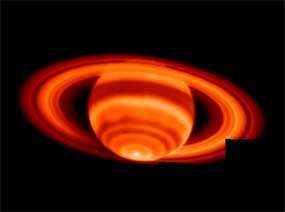
NASA astronomers using the Keck I telescope in Hawaii are learning much more about a strange, thermal "hot spot" on the tip of Saturn's south pole. In the most precise reading of Saturn's temperatures ever taken from Earth, a new set of infrared images suggests a warm "polar vortex" at Saturn's south pole - the first warm polar cap ever to be discovered in the solar system. The vortex is punctuated by a compact spot that is the warmest place on the planet. The researchers report their findings in the Feb. 4 issue of the journal Science.
Image: This is the sharpest image of Saturn's temperature emissions taken from the ground; it is a mosaic of 35 individual exposures made at the W.M. Keck I Observatory, Mauna Kea, Hawaii on Feb. 4, 2004. The images to create this mosaic were taken with infrared radiation. The warming of the southern hemisphere was expected, as Saturn was just past southern summer solstice, but the abrupt changes in temperature with latitude were not expected.
A polar vortex is a persistent, large-scale weather pattern, likened to a jet stream on Earth in the upper atmosphere. On Earth, the Arctic Polar Vortex is typically located over eastern Canada and plunges arctic air to the northern plains in the United States. Earth's cold Antarctic Polar Vortex, centered over Antarctica, traps air and creates unusual chemistry, such as the effects that create the "ozone hole".
Polar vortices on Earth, Jupiter, Mars and Venus are colder than their surroundings. But new images from the W. M. Keck Observatory show the first evidence of such a polar vortex at much warmer temperatures than their surroundings. And the even warmer, compact region at the pole itself is quite unusual.
"There is nothing like this compact warm 'cap' in the Earth's atmosphere," said Dr. Glenn S. Orton, senior research scientist at NASA's Jet Propulsion Laboratory in Pasadena, Calif., and lead author of the paper. "Meteorologists have detected sudden warming of the pole, but on Earth this effect is very short-term. This phenomenon on Saturn is longer-lived because we've been seeing hints of it in our data for at least two years."
Data for these observations were taken in the imaging mode of the Keck facility instrument, the Long Wavelength Spectrometer, on Feb. 4, 2004, by Orton and Dr. Padma Yanamandra-Fisher, the paper's co-author, also a research scientist at JPL.
The puzzle isn't that Saturn's south pole is warm; after all, it has been exposed to 15 years of continuous sunlight, having just reached its summer Solstice late in 2002. But both the distinct boundary of a warm polar vortex some 30 degrees latitude from the southern pole and a very hot "tip" right at the pole were completely unexpected. If the increased southern temperatures are the result of the seasonal variations of sunlight, then temperatures should increase gradually with increasing latitude. But they don't - the tropospheric temperature increases toward the pole abruptly near 70 degrees latitude from 88 to 89 Kelvin (-301 to -299 degrees Fahrenheit) and then to 91 Kelvin (-296 degrees Fahrenheit) right at the pole. Near 70 degrees latitude, the stratospheric temperature increases even more abruptly from 146 to 150 Kelvin (-197 to -189 degrees Fahrenheit) and then again to 151 Kelvin (-188 degrees Fahrenheit) right at the pole.
The abrupt temperature changes may be caused by a concentration of sunlight-absorbing particulates trapping heat in Saturn's upper atmosphere. This theory would explain why the hot spot appears dark in visible light and contains the highest measured temperatures on Saturn. However, this alone would not explain why the particles themselves are constrained to a compact area at Saturn's south pole. One possible explanation would be downwelling of dry air, which is also consistent with deeper clouds observed at the southern pole. Researchers plan more observations to check that possibility.
More detail about the temperatures and possible chemical changes in these regions may be available from an infrared spectrometer on the Cassini spacecraft, in orbit around Saturn. The discovery of the hot spot at Saturn's south pole has prompted Cassini's composite infrared spectrometer science team, including Orton, to redirect some future observations to this area.
"One of the obvious questions is whether Saturn's north pole is abnormally cold and whether a cold polar vortex has been established there. That's something we can't see from Earth, and Cassini's instruments will be in a unique position to observe it," said Orton.


