Tiny superconductors withstand stronger magnetic fields
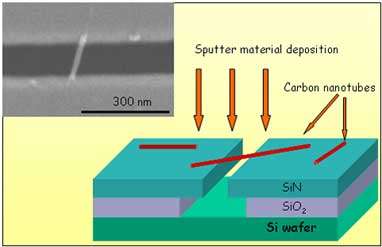
February 4th, 2005 Principle of molecular templating

Ultrathin superconducting wires can withstand stronger magnetic fields than larger wires made from the same material, researchers now report. This finding may be useful for technologies that employ superconducting magnets, such as magnetic resonance imaging.

As described in the Jan. 14 issue of the journal Physical Review Letters, researchers at the University of Illinois at Urbana-Champaign have created high-quality superconducting wires with molecular dimensions, and measured their behavior in magnetic fields of various strengths. The observational results have confirmed that theories developed for bulk superconductors also apply to molecular-scale superconductors.

“Our experimental results show an excellent agreement with the theory of pair-breaking perturbations, even at high magnetic fields,” said Alexey Bezryadin, a professor of physics at Illinois. “The theory takes into account both spin and orbital contributions.”
To study this phenomenon, the researchers began by placing a single-wall carbon nanotube across a narrow trench (about 100 nanometers wide) etched in the surface of a silicon wafer. The nanotube was then coated with a thin film of superconducting material (molybdenum-germanium), chilled below its critical temperature, and its properties measured in the presence of a magnetic field.

“Usually, when you apply a magnetic field to a superconductor, the field suppresses or even destroys the superconductivity,” Bezryadin said. “The magnetic field pulls apart the two electrons forming Cooper pairs and also rotates their spins. As the superconductor becomes smaller, however, the destructive effects of the magnetic field become weaker.”

The magnetic field showed a remarkably weak effect on nanowires, the researchers report. Both the orbital and the spin pair-breaking effects were strongly suppressed in the nanowires. The orbital effect was weak because of the small dimensions of the wire (about 10 nanometers in diameter) and the spin effect was weakened by spin-orbit interactions.

“One should not set a goal of reducing the wire’s diameter indefinitely, however,” Bezryadin said. “As the diameter is decreased, disorder and boundary effects become more and more important. These factors also weaken superconductivity.”

In fact, the researchers’ results show that thin wires do not really have zero resistance, as bulk samples do. They also show that the thinner the wire the higher its electrical resistance is.

Because nanoscale superconductors don’t repel magnetic fields, they could prove useful in a variety of superconducting applications. By incorporating nanowires as filaments in bigger superconducting wires, for example, more current could be carried without being destroyed by a magnetic field.

“Again, one needs to optimize the diameters of the wires in order to produce cables with the highest ability to carry strong currents and withstand strong magnetic fields,” Bezryadin said. “The nanowire should not be too thick, in order to be less sensitive to magnetic fields; but it also should not be too thin, in order to be fully superconducting. A correct balance should be achieved.”

Source: University of Illinois at Urbana-Champaign


print this article email this article download pdf blog this article bookmark this article     Digg this Stumble it share on Facebook share on Reddit add to delicious save to Yahoo! bookmarks
2.6/5 after 5 votes


February 4th, 2005 all stories
Nanotechnology /

Comments: 0
Rank: 2.6/5 after 5 votes

  • Stumble this up

  • Digg this

  • Share it:
  • share on Facebook
  • share on MySpace
  • share on Slashdot
  • rss-newsfeed
  • share on Google
  • share on Reddit
  • add to delicious
  • save to Yahoo! bookmarks
  • share on Windows Live
  • Add to Mixx!
Rating: 2.6/5 after 5 votes


Tags


  • Physicists Demonstrate Quantum Memory with Matter Qubits
    Physicists Demonstrate Quantum Memory with Matter Qubits
    Physics / General Physics
    created Jul 03, 2009 | popularity 4.4 / 5 (17) | comments 1
  • 'Holey' Nanosheets for Wastewater Dye Removal
    Nanotechnology / Nanomaterials
    created Jul 01, 2009 | popularity 5 / 5 (5) | comments 1
  • Jellyfish Robot Swims Like its Biological Counterpart
    Jellyfish Robot Swims Like its Biological Counterpart
    Electronics / Robotics
    created Jun 26, 2009 | popularity 4.4 / 5 (8) | comments 1
  • Could Maxwell's Demon Exist in Nanoscale Systems?
    Could Maxwell's Demon Exist in Nanoscale Systems?
    Physics / General Physics
    created Jun 24, 2009 | popularity 4.4 / 5 (18) | comments 29
  • Living Safely with Robots, Beyond Asimov's Laws
    Living Safely with Robots, Beyond Asimov's Laws
    Electronics / Robotics
    created Jun 22, 2009 | popularity 4.6 / 5 (52) | comments 40
  • Other News

    A 'quantum of sol' -- how nanotechnology could hold the key to a solar-powered future

    A 'quantum of sol' -- how nanotechnology could hold the key to a solar-powered future

    Nanotechnology / Nanomaterials

    created Jun 30, 2009 | popularity 3.9 / 5 (15) | comments 17

    (PhysOrg.com) -- A new generation of 'nano-structured' millimetre-sized solar cells that could convert the sun's energy to electricity more than twice as efficiently as current technology, is the subject of ...


    Australian researchers are set to begin human trials of a tiny nano-cell that acts as a "Trojan horse" against cancer

    Hi-tech 'Trojan horse' can kill cancer cells: researchers

    Nanotechnology / Bio & Medicine

    created Jun 29, 2009 | popularity 4.7 / 5 (12) | comments 7

    Australian researchers are set to begin human trials of a tiny nano-cell that acts as a "Trojan horse" against cancer cells, a breakthrough they say may curb the need for debilitating chemotherapy.


    'Holey' Nanosheets for Wastewater Dye Removal

    Nanotechnology / Nanomaterials

    created Jul 01, 2009 | popularity 5 / 5 (5) | comments 1

    (PhysOrg.com) -- Researchers have discovered that extremely thin sheets of nickel oxide with hexagonally shaped holes can absorb hazardous dyes from wastewater nearly as well as the best traditional methods, but are recyclable. ...


    Harnessing Nanoparticles To Track Cancer Cell Changes

    Nanotechnology / Bio & Medicine

    created Jul 03, 2009 | popularity not rated yet | comments 1

    The more dots there are, the more accurate a picture you get when you connect them. Cancer researchers adopting that philosophy have developed a new imaging technology that could give scientists the ability to simultaneously ...


    Computer-Guided Nanoparticle Therapy Destroys Tumors

    Nanotechnology / Bio & Medicine

    created Jun 29, 2009 | popularity 4.9 / 5 (12) | comments 0

    Gold nanoshells are among the most promising new nanoscale therapeutics being developed to kill tumors, acting as antennas that turn light energy into heat that cooks cancer to death. Now, a multi-institutional research team ...