Sumatra earthquake three times larger than originally thought
February 8, 2005
Northwestern University seismologists have determined that the Dec. 26 Sumatra earthquake that set off a deadly tsunami throughout the Indian Ocean was three times larger than originally thought, making it the second largest earthquake ever instrumentally recorded and explaining why the tsunami was so destructive.
By analyzing seismograms from the earthquake, Seth Stein and Emile Okal, both professors of geological sciences in Northwestern's Weinberg College of Arts and Sciences, calculated that the earthquake's magnitude measured 9.3, not 9.0, and thus was three times larger. These results have implications for why Sri Lanka suffered such a great impact and also indicate that the chances of similar large tsumanis occurring in the same area are reduced.
"The rupture zone was much larger than previously thought," said Stein. "The initial calculations that it was a 9.0 earthquake did not take into account what we call slow slip, where the fault, delineated by aftershocks, shifted more slowly. The additional energy released by slow slip along the 1,200-kilometer long fault played a key role in generating the devastating tsunami."
The large tsunami amplitudes that occurred in Sri Lanka and India, said tsunami expert Okal, result from rupture on the northern, north-trending segment of the fault -- the area of slow slip -- because tsunami amplitudes are largest perpendicular to the fault.
Because the entire rupture zone slipped (both fast and slow slip fault areas), strain accumulated from subduction of the Indian plate beneath the Burma microplate has been released, leaving no immediate danger of a comparable ocean-wide tsunami being generated on this segment of the plate boundary. However, the danger of a local tsunami due to a powerful aftershock or a large tsunami resulting from a great earthquake on segments to the south remains.
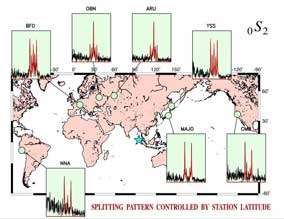
The analysis technique used by Stein and Okal to extract these data from the earth's longest period vibrations (normal modes) relied on results developed by them and colleague Robert Geller (now at the University of Tokyo) in their graduate studies almost 30 years ago. However, because such gigantic earthquakes are rare, these methods had been essentially unused until records of the Sumatra earthquake on modern seismometers became available.
The largest earthquake ever recorded, which measured 9.5, was in Chile on May 22, 1960.
-
Stanford scientists' computer models help predict tsunami risk
Dec 14, 2011 |
5 / 5 (1) |
1
-
Lessons from the Christchurch, New Zealand earthquake
Nov 01, 2011 |
4.8 / 5 (5) |
0
-
US scientists testing earthquake early warning
Sep 20, 2011 |
5 / 5 (2) |
1
-
Undersea clues to Haiti's earthquake history
Jul 22, 2011 |
5 / 5 (1) |
0
-
Greater tsunami threat identified
Jun 21, 2011 |
3.5 / 5 (2) |
0
-
Engineers build first sub-10-nm carbon nanotube transistor
Feb 01, 2012 |
4.9 / 5 (31) |
30
-
Something old, something new: Evolution and the structural divergence of duplicate genes
Jan 31, 2012 |
4.6 / 5 (7) |
1
-
The hidden nanoworld of ice crystals: Revealing the dynamic behavior of quasi-liquid layers
Jan 30, 2012 |
5 / 5 (3) |
1
-
Stock market network reveals investor clustering
Jan 27, 2012 |
3.9 / 5 (23) |
8
-
Of microchemistry and molecules: Electronic microfluidic device synthesizes biocompatible probes
Jan 26, 2012 |
5 / 5 (1) |
0
More news stories
Could Venus be shifting gear?
(PhysOrg.com) -- ESAs Venus Express spacecraft has discovered that our cloud-covered neighbour spins a little slower than previously measured. Peering through the dense atmosphere in the infrared, the ...
Space & Earth / Space Exploration
22 hours ago |
5 / 5 (8) |
8
|
Two new moons for Jupiter
Advances in technology have lead to the discovery of new planets outside of our Solar System, and now even new moons in our own backyard.
Space & Earth / Space Exploration
22 hours ago |
4 / 5 (1) |
7
Mars Science Laboratory computer issue resolved
(PhysOrg.com) -- Engineers have found the root cause of a computer reset that occurred two months ago on NASA's Mars Science Laboratory and have determined how to correct it.
Space & Earth / Space Exploration
23 hours ago |
4.6 / 5 (7) |
4
|
NASA sees wide-eyed cyclone Jasmine
Cyclone Jasmine's eye has opened wider on NASA satellite imagery, as it moves through the Southern Pacific Ocean.
Space & Earth / Earth Sciences
14 hours ago |
3.5 / 5 (2) |
2
Clam fields found at deep, low-temperature Mariana vents
(PhysOrg.com) -- Scientists have marveled at the unusual life forms thriving at high temperature hydrothermal vents of the deep ocean.
Space & Earth / Earth Sciences
23 hours ago |
4.3 / 5 (3) |
0
|
Anonymous knocks CIA website offline (Update)
The website of the Central Intelligence Agency was inaccessible on Friday after the hacker group Anonymous claimed to have knocked it offline.
Small modular reactor design could be a 'SUPERSTAR'
(PhysOrg.com) -- Though most of today's nuclear reactors are cooled by water, we've long known that there are alternatives; in fact, the world's first nuclear-powered electricity in 1951 came from a reactor ...
New power source discovered
(PhysOrg.com) -- Researchers at the Massachusetts Institute of Technology (MIT) and RMIT University have made a breakthrough in energy storage and power generation.
The power of estrogen -- male snakes attract other males
A new study has shown that boosting the estrogen levels of male garter snakes causes them to secrete the same pheromones that females use to attract suitors, and turned the males into just about the sexiest ...
Advanced power-grid model finds low-cost, low-carbon future in West
(PhysOrg.com) -- The least expensive way for the Western U.S. to reduce greenhouse gas emissions enough to help prevent the worst consequences of global warming is to replace coal with renewable and other ...
Fool's gold may prove an unlikely alternative to overexploited catalytic materials
Catalytic materials, which lower the energy barriers for chemical reactions, are used in everything from the commercial production of chemicals to catalytic converters in car engines. However, with current catalytic materials ...