World's First Flexible 8-Bit Asynchronous Microprocessor
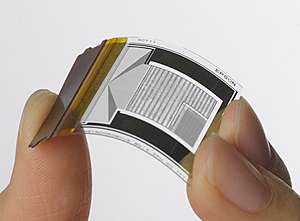
Seiko Epson has announced that it has developed the world's first flexible 8-bit asynchronous microprocessor using low-temperature polysilicon thin-film transistors (LTPS-TFTs) on a plastic substrate. With energy consumption reduced by 70% compared to the synchronous microprocessors now in everyday use, Epson is now researching potential applications for its invention. The results of Epson's research were announced at ISSCC2005, the International Solid-State Circuit Conference, held earlier this month in San Francisco in the United States.
The combination of Epson's original SUFTLA technology, LTPS-TFTs technology, and asynchronous circuit design technology has made it possible for Epson to create stable displays that are large in size, and that use substrates that are both flexible and variable in shape. SUFTLA is an Epson developed technique that makes it possible to transfer LTPS-TFT circuits onto flexible substrates.
"Saving," has long been the key theme to Epson's electronic device development with Epson products well known for their energy saving, space saving and resource saving. In the current project, Epson is aiming to build on its traditional strengths to firmly establish the field of flexible microelectronics technology.
Using the asynchronous circuit design technology, Epson has been able to:
1. Make a stable 8-bit microprocessor composed of 32,000 LTPS-TFTs,
2. Achieve energy consumption 70% lower than the synchronous design, and
3. Reduce electromagnetic radiation by 20dB.
The current invention is the first time in the world for an operational 8-bit asynchronous microprocessor to be formed on a flexible substrate.
Epson believes that technologies allowing flexibility will be of critical importance as demand for ubiquitous mobile devices continues to grow. Epson's forthcoming R&D into asynchronous microprocessors will concentrate on establishing this technology on a practical level, as well as searching for potential applications.


