First critical parts of giant neutrino telescope in place
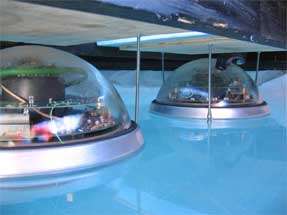
Working under harsh Antarctic conditions, an international team of scientists, engineers and technicians has set in place the first critical elements of a massive neutrino telescope at the South Pole. The successful deployment - in a 1.5 mile-deep hole drilled into the Antarctic ice - of a string of 60 optical detectors designed to sample phantom-like high-energy particles from deep space represents a key first step in the construction of the $272 million telescope known as IceCube.
The telescope and its construction are being financed by the National Science Foundation (NSF), which will provide $242 million. An additional $30 million in support will come from foreign partners.
"It's all on track," according to Francis Halzen, a University of Wisconsin-Madison professor of physics and the principal investigator for the project. "This was our first exam. We met our milestones for the season and we can move on to the next Antarctic summer."
In an announcement today (Feb. 15), scientists and managers of the project declared a successful first season of construction of what will become the world's largest scientific instrument.
Building the telescope requires drilling at least 70 one-and-one-half-mile-deep holes in the Antarctic ice using a novel hot-water drill, and then lowering long strings of volleyball-sized optical detectors - 4,200 in all - into the holes, where they will be frozen in place.
The first string, with 60 detectors, was successfully lowered into the ice in late January, and communication with the detectors, each of which is like a small computer, has been successfully established.
When completed, the telescope will utilize a cubic kilometer of Antarctic ice as a detector, and will be capable of capturing information-laden, high-energy particles from some of the most distant and violent events in the universe. It promises a new window to the heavens, and it may be astronomy's best bet to resolve the century-old quest to identify the sources of cosmic rays.
The IceCube telescope will look for the telltale signatures of high-energy cosmic neutrinos, ghostlike particles produced in violent cosmic events - colliding galaxies, distant black holes, quasars and other phenomena occurring at the very margins of the universe. Cosmic rays, which are composed of protons, are thought to be generated by these same events. But protons are bent by the magnetic fields of interstellar space, preventing scientists from following them back to their points of origin.
Cosmic neutrinos, on the other hand, have the unique ability to travel cosmological distances without being absorbed or deflected by the stars, galaxies and interstellar magnetic fields that permeate space. Their ability to skip through matter without missing a beat promises unedited information about the early universe and the very violent objects that populate deep space.
But that same phantom-like property - the ability to travel billions of light years and pass unhindered through planets, stars and galaxies - makes detecting cosmic neutrinos extraordinarily difficult.
"Neutrinos travel like bullets through a rainstorm," Halzen explains. "Immense instruments are required to find neutrinos in sufficient numbers to trace their origin."
The optical modules that make up the detector act like light bulbs in reverse. They are able to sense the fleeting flash of light created when neutrinos passing through the Earth from the Northern Hemisphere occasionally collide with other atoms. The subatomic wreck creates another particle called a muon. The muon leaves a trail of blue light in its wake that allows scientists to trace its direction, back to a point of origin, potentially identifying the cosmic accelerators - black holes or crashing galaxies, for example - that produce the high-energy neutrinos.
The telescope now under construction at the South Pole is an international effort involving more than 20 institutions. The project is funded by the U.S. National Science Foundation, with significant contributions from Germany, Sweden, Belgium, Japan, New Zealand, the Netherlands and the Wisconsin Alumni Research Foundation. In the U.S., the project involves scientists from UW-Madison, the University of California at Berkeley, the Lawrence Berkeley National Laboratory, the University of Maryland, Penn State University, the University of Wisconsin-River Falls, the University of Delaware, the University of Kansas, Clark Atlanta University, Southern University and A&M College, and the Institute for Advanced Study.
"UW-Madison's participation in this project has benefited significantly from the willingness of Wisconsin's Congressional delegation to understand and support the science behind it," says UW-Madison Chancellor John D. Wiley. "The deployment of the first IceCube string is the culmination of years of work to ensure that the telescope would be built."
This year marks the first year of work on the IceCube telescope, which is being built around a much smaller neutrino telescope known as AMANDA, for Antarctic Muon and Neutrino Detector Array.
"We've had an extremely productive year," says Jim Yeck, the IceCube project director. Accomplishments include fabrication of telescope instrumentation at collaborating institutions; the shipment of almost 1 million pounds of cargo to the South Pole; assembly and successful operation of the custom-built hot water drill; installation of facilities and instrumentation on the ice, including surface tanks with optical detectors (IceTop); and setting the first IceCube string into the ice. The first IceCube strings included optical detectors produced in Madison, Berlin and Stockholm. Data from the strings and the surface tanks is now being successfully transmitted to the Northern Hemisphere.
The hot-water drill system alone was transported to the South Pole from McMurdo Station on the Antarctic coast in 30 separate C-130 flights.
"We met all of the high-level milestones, including the most significant one, the installation of a string," Yeck says. Establishing the project at the South Pole, setting surface equipment in place and testing the powerful new drill meant the team had only a two-week window to drill the first hole and deploy the first IceCube string. Next year, with half of the three-month Austral season, the goal will be to drill holes for and deploy ten or more strings.
Although significant progress was made this year, there were setbacks, including an accident that injured a driller. The injured driller was evacuated from the Pole to a hospital in New Zealand and has since recovered.
"The safety of personnel living and working at the South Pole is an extremely high priority, in particular given the environment and harsh working conditions," Yeck says. "We responded to the accident very quickly by stopping drilling and placing equipment in standby mode until the appropriate safety reviews could be completed and the factors contributing to it could be addressed."
Yeck added that undertakings like the IceCube neutrino observatory and other polar science projects by U.S. researchers would not be possible without the strong logistics and science support provided by Raytheon Polar Services Co., the agency's prime support contractor in Antarctica, and without the strong support of the New York Air National Guard for air cargo and personnel delivery, and the U.S. Coast Guard for keeping sea lanes to the U.S. Antarctic coastal bases open.
Halzen expressed confidence the project would remain on track: "If we stay on schedule, IceCube could take over next year as the world's largest neutrino telescope."
Source: University of Wisconsin


