Nano Mechanism to Control Protein May Lead to New Protein Engineering
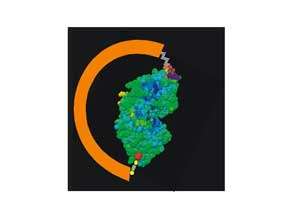
UCLA scientists have created a mechanism at the nanoscale to externally control the function and action of a protein.
"We can switch a protein on and off, and while we have controlled a specific protein, we believe our approach will work with virtually any protein," said Giovanni Zocchi, assistant professor of physics at UCLA, member of the California NanoSystems Institute and leader of the research effort. "This research has the potential to start a new approach to protein engineering."
The research, published in the journal Physical Review Letters, potentially could lead to a new generation of targeted "smart" pharmaceutical drugs that are active only in cells where a certain gene is expressed, or a certain DNA sequence is present, Zocchi said. Such drugs would have reduced side effects. The research, federally funded by the National Science Foundation, also may lead to a deeper understanding of proteins' molecular architecture.
Proteins are switched on and off in living cells by a mechanism called allosteric control; proteins are regulated by other molecules that bind to their surface, inducing a change of conformation, or distortion in the shape, of the protein, making the protein either active or inactive, Zocchi explained.
"We have made an artificial mechanism of allosteric control based on mechanical tension — the first time this has ever been done," Zocchi said. "Potentially, the applications could be very far-reaching and beneficial if the research continues to progress well.
"We insert a molecular spring on the protein, and we can control the stiffness of the spring externally," he said. "We chemically string a short piece of DNA around the protein. We can switch the protein on and off by changing the stiffness of the DNA. We have made a new molecule, which we can control. By gluing together two disparate pieces of the cell's molecular machinery, a protein and a piece of DNA, we have created a spring-loaded protein which can be turned on and off."
Zocchi's graduate student, Brian Choi, worked with a transport protein called MBP (maltose binding protein), expressed in a bacterium. The MBP protein binds and transports a sugar.
The first applications Zocchi foresees for the new molecules are as amplified molecular probes. Currently it is difficult for scientists to study a single live cell and find what gene it is expressing, but with an amplified molecular probe, in principle one could inject the probe into a single cell and detect that the cell is expressing a particular gene, Zocchi said.
An amplified molecular probe would make it possible to study the individuality of cells, with applications in stem cell research and the early detection of disease, said Zocchi, whose laboratory was established in part through start-up funding from UCLA's Division of Physical Sciences.
"I'm interested in conformational changes of macromolecules, and in understanding the physical basis of this allosteric mechanism, which is central to the regulation in the cell," Zocchi said.
Zocchi's co-authors, in addition to Choi, are L. Jeanne Perry, director of UCLA's Protein Expression Technology Center in the Institute for Genomics and Proteomics and adjunct associate professor of molecular, cell and developmental biology; former UCLA undergraduate Stephen Canale; and staff researchers Yim Wu and Sum Chan.
The research was published in the Jan. 28 issue of Physical Review Letters.
Source: UCLA


