Saturn's Aurora Defy Scientists' Expectations
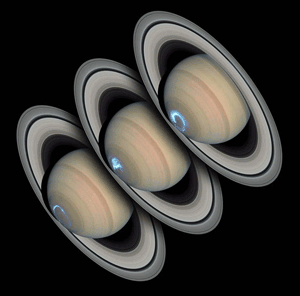
Aurora on Saturn behave in ways different from how scientists have thought possible for the last 25 years, according to new research by a team of astronomers led by John Clarke, a professor in BU’s Department of Astronomy and in the department’s Center for Space Physics. The team’s findings have overturned theories about how Saturn’s magnetosphere behaves and how its aurora are generated. Their results will be published in the February 17 issue of Nature.
Image: Hubble Space Telescope images of Saturn and its polar auroral emissions on 24, 26, and 28 January 2004. Each of the three images of Saturn combines ultraviolet images of the south polar region (to show the auroral emissions) with visible wavelength images of the planet and rings. The HST images were obtained during a campaign by the Cassini spacecraft to measure the solar wind approaching Saturn and the Saturn kilometric emissions. The strong brightening of the aurora on 28 January corresponded with the recent arrival of a large disturbance in the solar wind. (Photo courtesy of Z. Levay, Space Telescope Science Institute and J. Clarke, Boston University)
In an unusual coordination of two spacecraft, the team was able to gather what proved to be startling data on Saturn’s aurora. By choreographing the instruments aboard the Saturn-bound Cassini spacecraft and the Hubble Space Telescope circling Earth to look at Saturn’s southern polar region, Clarke and his team found that the planet’s aurora, long thought of as a cross between those of Earth and Jupiter, are fundamentally unlike those observed on either of the other two planets. The lights that occasionally paint the sky over Saturn may, in fact, be a phenomenon unique within our solar system.
In Clarke’s experiment, Hubble snapped ultraviolet pictures of Saturn’s aurora over several weeks and Cassini recorded radio emissions from the same regions while measuring the solar wind. Those measurements sets were combined to yield the most accurate glimpse yet of Saturn’s aurora.
The observations showed that Saturn’s aurora differ in character from day to day, as they do on Earth, moving around on some days and stationary on others. But compared to Earth’s auroral displays, which last only about 10 minutes, Saturn’s aurora can last for days.
The observations also indicated, surprisingly, that the sun’s magnetic field and solar wind may play a much larger role in Saturn’s aurora than previously suspected. Hubble images show that some displays remain stationary as the planet rotates beneath, as happens on Earth, but also show that, as on Jupiter, the aurora sometime move along with Saturn as it spins on its axis. This difference suggests that Saturn’s aurora are driven in an unexpected manner by the sun’s magnetic field and the solar wind and that the planet’s aurora possibly have different physical states at different times.
Seen from space, an aurora appears as a ring of energy circling a planet’s polar region. Auroral displays are spurred when charged particles in space interact with a planet’s magnetosphere and stream into the upper atmosphere. Collisions with atoms and molecules produce flashes of radiant energy in the form of visible, ultraviolet, and infrared light.
Scientists had long believed Saturn’s aurora possess properties akin to auroras on Earth and Jupiter—like Earth’s, they were thought to be influenced by the solar wind; and like Jupiter’s, they were assumed to be influenced by a ring of ions and charged particles encircling the planet.
But, as the team observed, although Saturn’s aurora do share characteristics with the other planets, they are fundamentally unlike the auroral displays on either Earth or Jupiter. When Saturn’s aurora become brighter (and thus more powerful), the ring of energy encircling the pole shrinks in diameter. By contrast, when Earth’s aurora become brighter, the polar region fills with light for several minutes, then dims, and the ring of light expands. Jupiter’s aurora, in comparison, are only weakly influenced by the solar wind, becoming brighter about once a month.
Saturn’s auroral displays also become brighter on the sector of the planet where night turns to day as the storms increase in intensity, unlike either of the other two planets. At certain times, Saturn’s auroral ring was more like a spiral, its ends not connected as the energy storm circled the pole.
Now that Cassini has entered orbit around Saturn, Clarke and his team will be able to take a more direct look at the how the planet’s aurora are generated. According to Clarke, the team’s next effort will be to study in greater detail how Saturn’s auroral emissions are influenced by the planet’s magnetic field.
The Cassini/Huygens mission was launched in 1997 and is jointly operated by the European Space Agency and NASA’s Jet Propulsion Laboratory in Pasadena, California. Cassini arrived in orbit around Saturn in July 2004 and will spend four years exploring the sixth planet, its moons and mysterious rings. NASA’s Hubble Space Telescope is a cooperative program with the European Space Agency and is operated by the Space Telescope Science Institute on the Johns Hopkins University Homewood Campus in Baltimore, Maryland. Hubble has spent the last 14 years orbiting Earth snapping pictures of the cosmos.
Faculty research in BU’s Department of Astronomy is coordinated through its Institute for Astrophysical Research and its Center for Space Physics. Boston University, with an enrollment of more than 29,000 in its 17 schools and colleges, is the fourth-largest independent university in the United States.


