Philips' fluid Lenses Bring Things into Focus; Unique Variable-Focus With No Mechanical Moving Parts
July 3, 2004
Philips Research has demonstrated a unique variable-focus lens system that has no mechanical moving parts. Suited to a wide range of optical imaging applications, including such things as digital cameras, camera phones, endoscopes, home security systems and optical storage drives, Philips' FluidFocus system mimics the action of the human eye using a fluid lens that alters its focal length by changing its shape. The new lens, which lends itself to high volume manufacturing, overcomes the fixed-focus disadvantages of many of today's low-cost imaging systems.
The Philips FluidFocus lens consists of two immiscible (non-mixing) fluids of different refractive index (optical properties), one an electrically conducting aqueous solution and the other an electrically non-conducting oil, contained in a short tube with transparent end caps. The internal surfaces of the tube wall and one of its end caps are coated with a hydrophobic (water-repellent) coating that causes the aqueous solution to form itself into a hemispherical mass at the opposite end of the tube, where it acts as a spherically curved lens.
The shape of the lens is adjusted by applying an electric field across the hydrophobic coating such that it becomes less hydrophobic - a process called 'electrowetting' that results from an electrically induced change in surface-tension. As a result of this change in surface-tension the aqueous solution begins to wet the sidewalls of the tube, altering the radius of curvature of the meniscus between the two fluids and hence the focal length of the lens. By increasing the applied electric field the surface of the initially convex lens can be made completely flat (no lens effect) or even concave. As a result it is possible to implement lenses that transition smoothly from being convergent to divergent and back again.
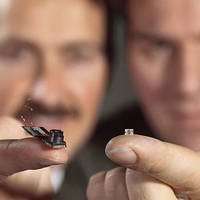
In the FluidFocus technology demonstrator, the fluid lens measures a mere 3 mm in diameter by 2.2 mm in length, making it easy to incorporate into miniature optical pathways. The focal range provided by the demonstrator extends from 5 cm to infinity and it is extremely fast: switching over the full focal range is obtained in less than 10 ms. Controlled by a dc voltage and presenting a capacitive load, the lens consumes virtually zero power, which for battery powered portable applications gives it a real advantage. The durability of the lens is also very high, Philips having already tested the lens with over 1 million focusing operations without loss of optical performance. It also has the potential to be both shock resistant and capable of operating over a wide temperature range, suiting it for mobile applications. Its construction is regarded as compatible with high-volume manufacturing techniques.
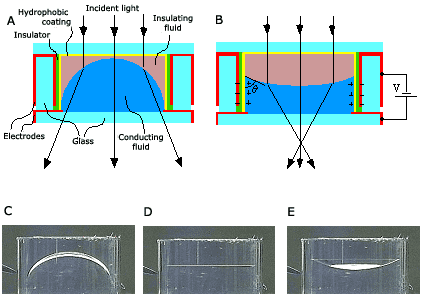
(A) Schematic cross section of the FluidFocus lens principle. ( B ) When a voltage is applied, charges accumulate in the glass wall electrode and opposite charges collect near the solid/liquid interface in the conducting liquid. The resulting electrostatic force lowers the solid/liquid interfacial tension and with that the contact angle θ and hence the focal distance of the lens. (C) to (E) Shapes of a 6-mm diameter lens taken at different applied voltages.
The original press release can be found here.
-
Proteins in focus: Adjustable protein microlenses made by femtosecond laser direct writing
Dec 16, 2011 |
5 / 5 (1) |
0
-
Beyond brain scanning: Simultaneous high-resolution 3D neural imaging and photostimulation
Nov 28, 2011 |
5 / 5 (8) |
2
-
Nanowire lens can reconfigure its imaging properties
Oct 11, 2011 |
5 / 5 (11) |
3
-
'Next-generation' optical tweezers trap tightly without overheating (w/ video)
Sep 26, 2011 |
5 / 5 (2) |
3
-
Lasers used to form 3-D crystals made of nanoparticles (w/ video)
Jun 01, 2011 |
5 / 5 (1) |
0
-
Engineers build first sub-10-nm carbon nanotube transistor
Feb 01, 2012 |
4.9 / 5 (31) |
30
-
Something old, something new: Evolution and the structural divergence of duplicate genes
Jan 31, 2012 |
4.6 / 5 (7) |
1
-
The hidden nanoworld of ice crystals: Revealing the dynamic behavior of quasi-liquid layers
Jan 30, 2012 |
5 / 5 (3) |
1
-
Stock market network reveals investor clustering
Jan 27, 2012 |
3.9 / 5 (23) |
8
-
Of microchemistry and molecules: Electronic microfluidic device synthesizes biocompatible probes
Jan 26, 2012 |
5 / 5 (1) |
0
More news stories
Walney offshore wind farm is world's biggest (for now)
(PhysOrg.com) -- The Walney wind farm on the Irish Sea--characterized by high tides, waves and windy weather--officially opened this week. The farm is treated in the press as a very big deal as the Walney ...
GPS court ruling leaves US phone tracking unclear
A US Supreme Court decision requiring a warrant to place a GPS device on the car of a criminal suspect leaves unresolved the bigger issue of police tracking using mobile phones, legal experts say.
55 minutes ago |
not rated yet |
0
Netflix settlement trims 14 pct off 4Q earnings
(AP) -- Netflix pressed the rewind button on its fourth-quarter earnings after settling allegations that the video subscription service violated a consumer-privacy law.
57 minutes ago |
not rated yet |
0
Anonymous briefly knocks CIA website offline (Update 2)
The website of the Central Intelligence Agency was briefly inaccessible on Friday after the hacker group Anonymous claimed to have knocked it offline.
17 hours ago |
4.7 / 5 (14) |
23
Google users warned of threat to smartphone wallets
Users of Google smartphone wallets were being warned on Friday that there is a way to crack pass codes intended to thwart thieves from going on illicit shopping sprees.
16 hours ago |
5 / 5 (3) |
0
Europe stakes billion-dollar bet on new rocket
A pencil-slim rocket is scheduled to lift into space from South America on Monday, carrying a billion-dollar bet that Europe can grab a juicy slice of the market to place satellites in low orbit.
Study finds that anti-diabetic medication can prevent the long-term effects of maternal obesity
In a study to be presented today at the Society for Maternal-Fetal Medicine's annual meeting, The Pregnancy Meeting, in Dallas, Texas, researchers will report findings that show that short therapy with the anti-diabetic medication ...
Elbow position not a predictor of injury
Elbow position alone appeared to not affect injury rates and performance in college-level, male pitchers say researchers presenting at the American Orthopaedic Society for Sports Medicine's Specialty Day in San Francisco, ...
New data provides direction for ACL injured knee treatments
Primary Anterior Cruciate Ligament (ACL) reconstruction improves quality of life and sports functionality for athletes, according to research presented today at the American Orthopaedic Society for Sports Medicine's Specialty ...
Treatment for hip conditions should not rest solely on MRI scans
When it comes to treating people with hip pain, physicians should not replace clinical observation with the use of magnetic resonance images (MRI), according to research being presented today at the American Orthopaedic Society ...
Delaying ACL reconstruction in kids may lead to higher rates of associated knee injuries
Kids treated more than 150 days after an Anterior Cruciate Ligament (ACL) injury have higher rates of other knee injuries, including medial meniscal tears, say researchers presenting at the American Orthopaedic Society for ...