The Oldest Homo sapiens
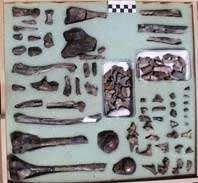
When the bones of two early humans were found in 1967 near Kibish, Ethiopia, they were thought to be 130,000 years old. A few years ago, researchers found 154,000- to 160,000-year-old human bones at Herto, Ethiopia. Now, a new study of the 1967 fossil site indicates the earliest known members of our species, Homo sapiens, roamed Africa about 195,000 years ago.
“It pushes back the beginning of anatomically modern humans,” says geologist Frank Brown, a co-author of the study and dean of the University of Utah’s College of Mines and Earth Sciences.
The journal Nature is publishing the study in its Thursday Feb. 17, 2005, issue. Brown conducted the research with geologist and geochronologist Ian McDougall of Australian National University in Canberra, and anthropologist John Fleagle of New York state’s Stony Brook University.
The researchers dated mineral crystals in volcanic ash layers above and below layers of river sediments that contain the early human bones. They conclude the fossils are much older than a 104,000-year-old volcanic layer and very close in age to a 196,000-year-old layer, says Brown.
“These are the oldest well-dated fossils of modern humans (Homo sapiens) currently known anywhere in the world,” the scientists say in a summary of the study.
Significance of an Earlier Emergence of Homo sapiens
Brown says that pushing the emergence of Homo sapiens from about 160,000 years ago back to about 195,000 years ago “is significant because the cultural aspects of humanity in most cases appear much later in the record – only 50,000 years ago – which would mean 150,000 years of Homo sapiens without cultural stuff, such as evidence of eating fish, of harpoons, anything to do with music (flutes and that sort of thing), needles, even tools. This stuff all comes in very late, except for stone knife blades, which appeared between 50,000 and 200,000 years ago, depending on whom you believe.”
Fleagle adds: “There is a huge debate in the archeological literature regarding the first appearance of modern aspects of behavior such as bone carving for religious reasons, or tools (harpoons and things), ornamentation (bead jewelry and such), drawn images, arrowheads. They only appear as a coherent package about 50,000 years ago, and the first modern humans that left Africa between 50,000 and 40,000 years ago seem to have had the full set. As modern human anatomy is documented at earlier and earlier sites, it becomes evident that there was a great time gap between the appearance of the modern skeleton and ‘modern behavior.’”
The study moves the date of human skulls found in Ethiopia’s Kibish rock formation in 1967 back from 130,000 years to a newly determined date of 195,000 years ago, give or take 5,000 years. Fossils from an individual known as Omo I look like bones of modern humans, but other bones are from a more primitive cousin named Omo II.
In addition to the cultural question, the earlier date for humanity’s emergence is important for other reasons.
“First, it makes the dates in the fossil record almost exactly concordant with the dates suggested by genetic studies for the origin of our species,” Fleagle says. “Second, it places the first appearance of modern Homo sapiens in Africa many more thousands of years before our species appears on any other continent. It lengthens that gap. … Finally, the similar dating of the two skulls indicates that when modern humans first appeared there were other contemporary populations [Omo II] that were less modern.”
The study was funded by the National Science Foundation, the L. S. B. Leakey Foundation, the National Geographic Society and the Australian National University.
Modern Homo in the Valley of the Omo
Richard Leakey and his team of paleontologists traveled in 1967 to the Kibish Formation along the Omo River in southernmost Ethiopia, near the town of Kibish. They found the skull (minus the face) and partial skeleton (parts of arms, legs, feet and the pelvis) of Omo I, and the top and back of the skull of Omo II. Brown was not part of the 1967 expedition, but was working nearby and got to look at the site and the fossils.
“Anthropologists said they looked very different in their evolutionary status,” Brown recalls. “Omo I appeared to be essentially modern Homo sapiens, and Omo II appeared to be more primitive.”
In 1967, the fossils were dated as being 130,000 years old, although the scientists doubted the accuracy of their dating technique, which was based on the decay of uranium-238 to thorium-238 in oyster shells from a rock layer near the skulls.
Fleagle says no scientist has been bold enough to suggest Omo II is anything other than Homo sapiens, and that “quite often at the time of major events in evolution, one finds an increase in morphological [anatomical] diversity.” Now that the new study confirms Omo I and Omo II are the same age – living within a few hundred years of each other about 195,000 years ago – some anthropologist suggest “maybe it [Omo II] isn’t so primitive after all,” Brown says.
McDougall, Brown and Fleagle and researchers from other universities returned to Kibish in 1999, 2001, 2002 and 2003. They identified sites where Omo I and Omo II were found in 1967, and obtained more of Omo I, including part of the femur (upper leg bone) that fit a piece found in 1967. They also found animal fossils and stone tools, and studied local geology. The Nature study includes initial results from those expeditions.
The fossil record of human ancestors may go back 6 million years or more, and the genus Homo arose at least 1.8 million years ago when australopithecines evolved into human ancestors known as Homo habilis. Brown says the fossil record of humans is poor from 100,000 to 500,000 years ago, so Omo I is significant because it now is well dated.
Dating the Dawn of Humanity
Both Omo I and Omo II were buried in the lowermost portion or “member” of the Kibish Formation, a series of annual flood sediments laid down rapidly by the ancient Omo River on the delta where it once entered Lake Turkana. Lake levels now are much lower, and the river enters the lake about 60 miles (100 kilometers) south of Kibish.
The 330-foot-thick (100-meter-thick) formation is divided into at least four members, with each of the four sets of layers separated from the other by an “unconformity,” which represents a period of time when rock eroded away instead of being deposited. For example, the lowermost Kibish I member was deposited in layers as the Omo River flooded each year. After thousands of years, rainfall diminished, lake levels dropped, and the upper part of Kibish I eroded away. Later, the lake rose and deposition resumed to create layers of Kibish member II.
Interspersed among the river sediments are occasional layers of volcanic ash from ancient eruptions of nearby volcanoes. Some ash layers contain chunks of pumice, which in turn contain feldspar mineral crystals. Feldspar has small amounts of radioactive potassium-40, which decays into argon-40 gas at a known rate. The gas, trapped inside feldspar crystals, allows scientists to date the feldspar and the pumice and ash encasing it.
Brown says potassium-argon dating shows that a layer of ash no more than 10 feet (3 meters) below Omo I’s and Omo II’s burial place is 196,000 years old, give or take 2,000 years. Another layer is 104,000 years old. It is almost 160 feet (50 meters) above the layer that yielded the Omo humans. The unconformities represent periods of time when rock was eroded, so the fossils must be much older than the 104,000-year-old layer and close in age to the 196,000-year-old layer, Brown says.
The clinching evidence, he says, comes from sapropels, which are dark rock layers on the Mediterranean seafloor that were deposited when floods of fresh water poured out of the Nile River during rainy times. The Blue Nile and White Nile tributaries share a drainage divide with the Omo River. During ancient wet periods, monsoons on the Ethiopian highlands sent annual floods surging down the Nile system, causing sapropels to form on the seafloor, and sent floods down the Omo, making Lake Turkana rise and depositing Kibish Formation sediments on the river’s ancient delta. (During dry periods, Lake Turkana was smaller, flood sediments were deposited farther south and rocks at Kibish were eroded.)
No other sediments on land have been found to record wet and dry periods that correlate so well with the same climate pattern in ocean sediments, Brown says. The new study found that the “members” – or groups of rock layers – of the Kibish formation were laid down at the same time as the Mediterranean sapropels. In particular, the volcanic layer right beneath Omo I and II dates to 196,000 years ago by potassium-argon dating, and it corresponds almost perfectly to a sapropel layer previously dated as 195,000 years old, Brown says.
“It is pretty conclusive,” says Brown, who disputes any contention that the fossils might be closer to 104,000 years old.
Source: University of Utah


