Frozen sea discovered near Martian equator from 3D images of Mars Express
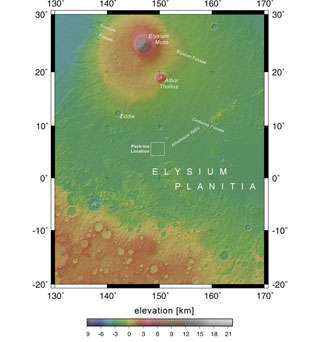
The discovery, by an international team of scientists led by University College London (UCL), the Open University (OU), and the Free University of Berlin, of a frozen sea close to the equator of Mars has brought the possibility of finding life on Mars one step closer. This is the first evidence of there having been recent liquid water on Mars. Higher levels of methane over the same area mean that primitive micro-organisms might survive on Mars today. The 3D images of pack ice near the Martian equator have been taken by the High Resolution Stereo Camera on board the Mars Express probe.
The results of the work by the team lead by John Murray (OU), Jan-Peter Muller (UCL), and Gerhard Neukum (Free University of Berlin) were presented at an ESA Mars Science Conference at ESTEC, Netherlands on 21 February 2005, and are to be published in the scientific journal Nature next month.
Professor Muller, Department of Geomatic Engineering, UCL, one of two UK co-investigators on the project, said: “This is a historic moment for Mars exploration when a previously neglected region reveals its secrets. Speculations that this area might have water close to the surface have been shown to be correct. This is one of many discoveries that we expect the European Space Agency to make with Mars Express and the Aurora programme, given future UK support.”
Dr Murray, of the Department of Earth Sciences at the OU, said “The fact that there have been warm and wet places beneath the surface of Mars since before life began on Earth, and that some are probably still there, means that there is a possibility that primitive micro-organisms survive on Mars today. This mission has changed many of my long-held opinions about Mars – we now have to go there and check it out”
The water that formed the sea appears to have originated beneath the surface of Mars. Erupting about 5 million years ago, from a series of fractures known as the Cerberus Fossae, the water flowed down in a catastrophic flood, collecting in an area 800 x 900 km and was initially an average of 45 metres deep. This means it was about the same size and depth as the North Sea. The pack ice, which formed on the surface of the sea, drew the attention of Mars Express scientists.
Although formed at the time when early hominids on Earth were evolving from apes, this is very recent in geological terms, and suggests that vast flooding events, which are known to have occurred from beneath Mars’ surface throughout its geological history, still happen. The presence of liquid water for thousands of millions of years, even beneath the surface, is a possible habitat in which primitive life may have developed, and might still be surviving now. Clearly this must now be considered as a prime site for future missions looking for life.
The pack-ice floes have drifted into obstacles, and in places have become grounded on islands when the water level dropped, but the very flat surface (similar in slope to water surfaces in estuaries on Earth when the tide is coming in) and the thick ice within enclosed craters suggests that most of the ice is still there. Ice is unstable at the surface of Mars because of the low atmospheric pressure, and sublimes away (changes straight from ice to vapour without passing through the liquid state) into the atmosphere, but the frozen sea appears to have been protected from this by a layer of volcanic ash and dust.
The Mars Express probe will be deploying its MARSIS experiment in May, a ground-penetrating radar instrument which is specifically designed to look for ice or water beneath the surface. If water ice is confirmed, this site represents a prime target for exobiology landers from the European Space Agency planned for the end of this decade. At the ESA Mars Science Conference, the PI of the Mars Express PFS instrument team stated that the region where the pack-ice was discovered is also the area where higher methane concentrations were discovered by PFS.
Mars Express, Europe’s first ever space mission to another planet, entered the orbit of Mars successfully on Christmas Day 2003, and since January 2004 the high resolution stereo camera on board has been taking a massive number of stereo images of the surface from altitudes as low as 270 km, showing details down to 10 metres. Around 23% of the Martian surface is now covered in 3D and full colour.
The 3D information means that, for the first time, scientists are able to make geological and geomorphological measurements of such quantities as dip, strike and thickness of sedimentary layers on another planet, just as geologists do on the Earth. The images also provide a wealth of information on past climate and water, as well as the relative ages of the surface from crater measurements on Mars, the evolution of volcanism, potential resources, characteristics of present and future landing sites, and observations of Mars’ two tiny moons, Phobos and Deimos.
Notes:
Mars Express is carrying out intense study of the surface of Mars for the next one to three years, depending on funding and the health of the instruments. One of the most exciting instruments on board is a High Resolution Stereo Camera (HRSC), with nine operating channels: triple stereo imaging, a super-high resolution channel, four colour channels and five phase angle channels.
There are two British Co-Investigators on this experiment: Prof. Jan-Peter Muller of University College London (UCL), and Dr John Murray of the Open University (OU). The Principal Investigator is Prof. Dr. Gerhard Neukum of the Free University of Berlin, and scientists from 10 countries are involved. The instrument has functioned perfectly so far. The spacecraft successfully entered Mars orbit on Christmas day 2003 and since mid January, the HRSC has taken a series of high resolution stereo images of the surface from altitudes as low as 270 km (168 miles) above the surface.
The HRSC experiment is planned to image the entire surface of Mars at 10-20 metre resolution over 50% of the surface for the 2 year nominal mission and 100% over an extended mission of 4 years, with selected targets at 2.5-4 metres resolution. In other words, we will have better knowledge of the surface of Mars than we do of the Earth. Not only that, but it will be imaged in triple stereo, providing detailed 3D information as well. Prof. Muller helped to develop the 3D mapping system in association with the German Space Agency (DLR) more than 10 years ago. This 3D mapping system worked immediately with the first pictures relayed back from Mars. Previously, Prof. Muller worked on the Voyager images of Jupiter and Saturn including the discovery of major Jovian hurricanes in 1979. Dr Murray worked on the results of several NASA missions, and was a guest scientist at the Jet Propulsion Laboratory, California, during the Viking Mission to Mars in 1976-77.
The paper ‘Evidence from the Mars Express High Resolution Stereo Camera for a frozen sea close to Mars’ equator ‘ by John B. Murray, Jan-Peter Muller, Gerhard Neukum, Stephanie C. Werner, Stephan van Gasselt, Ernst Hauber, Wojciech J. Markiewicz, James W. Head III, Bernard H. Foing, David Page, Karl L. Mitchell, Ganna Portyankina & the HRSC Co-Investigator Team is to be published in Nature on 17 March 2005
Source: University College London


