Saturn's A Ring has oxygen, but not life
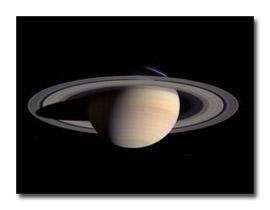
February 24, 2005 A natural color view of Saturn taken by the Cassini spacecraft on its approach to the planet

A natural color view of Saturn taken by the Cassini spacecraft on its approach to the planet

Data from the Cassini-Huygens satellite showing oxygen ions in the atmosphere around Saturn's rings suggests once again that molecular oxygen alone isn't a reliable indicator of whether a planet can support life.
That and other data are outlined in two papers in the Feb. 25 issue of the journal Science co-authored by University of Michigan engineering professors Tamas Gombosi, J. Hunter Waite and Kenneth Hansen; and T.E. Cravens from the University of Kansas. The papers belong to a series of publications on data collected by Cassini as it passed through the rings of Saturn on July 1.

Molecular oxygen forms when two oxygen atoms bond together and is known in chemical shorthand as O2. On Earth, it is a continual byproduct of plant respiration, and animals need this oxygen for life. But in Saturn's atmosphere, molecular oxygen was created without life present, through a chemical reaction with the sun's radiation and icy particles that comprise Saturn's rings.

"That means you don't need biology to produce an O2 atmosphere," Waite said. "If we want indicators to use in the search for life on other planets, we need to know what to look for. But oxygen alone isn't it."

Because Saturn's rings are made of water ice, one would expect to find atoms derived from water, such as atomic oxygen (one atom) rather than O2, Waite said. However, the paper, called "Oxygen Ions Observed Near Saturn's A Ring," suggests the formation of molecular oxygen atmospheres happens more often in the outer solar system than expected. There is earlier evidence of molecular oxygen atmospheres elsewhere in the solar system---for instance above the icy Galilean moons of Jupiter---he said.

Four U-M College of Engineering faculty members are involved in the Cassini mission to explore Saturn's rings and some of its moons. Waite leads the team operating the ion and neutral mass spectrometer, the instrument that detected and measured the molecular oxygen ions. Other team members are J.G. Luhmann of the University of California, Berkeley; R.V. Yelle, of the University of Arizona, Tuscon; W.T. Kasprzak, of the Goddard Space Flight Center; R.L. McNutt of Johns Hopkins University; and W.H. Ip, of the National Central University, Taiwan.

A second, viewpoint paper called, "Saturn's Variable Magnetosphere," by Hansen and Gombosi, who is chair of the College of Engineering's department of Atmospheric, Oceanic and Space Sciences, reviews key findings from the other Cassini teams, including new information that contradicts data gathered 25 years ago, when the space craft Voyager passed by the planet.

Source: University of Michigan


print this article email this article download pdf blog this article bookmark this article     Stumble it Digg this share on Facebook retweet share on Reddit add to delicious
Rate this story - not rated yet


February 24, 2005 all stories

Comments: 0

not rated yet
  • Stumble this up

  • Digg this

  • share this

  • hide
  • Related Stories

  • Researcher hunts for new planets, seeking clues on solar system's origin
    created Oct 13, 2009 | popularity not rated yet | comments 0
  • A Hazy View of Early Earth
    created Oct 12, 2009 | popularity not rated yet | comments 0
  • An Earth Day Perspective: NASA Satellites Aid in Chesapeake Bay Recovery
    created Apr 22, 2008 | popularity not rated yet | comments 0
  • New purdue facility aims to improve NASA moon rocket engine
    created Mar 10, 2008 | popularity not rated yet | comments 0
  • Red dust in planet-forming disk may harbor precursors to life
    created Jan 03, 2008 | popularity not rated yet | comments 0


Other News

NASA satellites see Ida spreading out before landfall

NASA satellites see Ida spreading out before landfall

Space & Earth / Earth Sciences

created 11 minutes ago | popularity not rated yet | comments 0

NASA's Aqua and Terra satellites are keeping a close eye on Tropical Storm Ida, and both have instruments aboard that show her clouds and rains are already widespread inland over the U.S. Gulf coast states. ...


L-R: Chiwetel Ejiofor, Amanda Peet and John Cusack at the premiere of "2012"

NASA on crusade to debunk 2012 apocalypse myths

Space & Earth / Space Exploration

created 4 hours ago | popularity not rated yet | comments 0

The world is not coming to an end on December 21, 2012, the US space agency insisted Monday in a rare campaign to dispel widespread rumors fueled by the Internet and a new Hollywood movie.


Making Climate Forecasts More Useful to Farmers

Making Climate Forecasts More Useful to Farmers

Space & Earth / Environment

created 2 hours ago | popularity not rated yet | comments 0

(PhysOrg.com) -- Climate forecasts are becoming more useful to farmers and ranchers, thanks to research by Agricultural Research Service (ARS) scientists and their cooperators.


Antarctica glacier retreat creates new carbon dioxide store

Antarctica glacier retreat creates new carbon dioxide store

Space & Earth / Earth Sciences

created 9 hours ago | popularity 4.3 / 5 (3) | comments 0

Large blooms of tiny marine plants called phytoplankton are flourishing in areas of open water left exposed by the recent and rapid melting of ice shelves and glaciers around the Antarctic Peninsula. This ...


NASA satellites make a movie and get rainfall, wind info on Ida

NASA satellites make a movie and get rainfall, wind info on Ida (w/ Video)

Space & Earth / Earth Sciences

created 4 hours ago | popularity not rated yet | comments 0

NASA satellites are amazing examples of technology. The TRMM satellite peers into tropical cyclones and can tell how much rain is falling per hour and where. QuikScat uses microwave technology to measure Ida's ...