World's First HTPS LCD Panel Using Inorganic Alignmnet Layer
February 24, 2005 Sony HTPS LCD

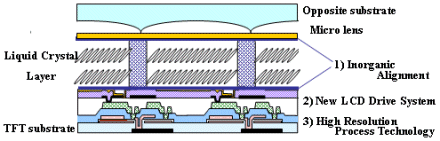
Representing the latest technology in precise liquid crystal alignment, Sony Corporation announced today the successful development of the world's first HTPS LCD panel for front projector TV sets, has increased reliability and is capable of outputting higher picture quality through the incorporation of an inorganic alignment layer. Compared to conventional LCD panels, the use of this new material nearly quadruples HTPS panels' resistance to light (illuminating on LCD)which is instrumental for higher brightness and contrast ratio (CR).

Additionally, Sony has introduced the new Field Inversion Driving method, a liquid crystal-driving system that modulates input voltages to all pixels simultaneously within one field. Unlike conventional systems which use a line-by-line writing method, the Field Inversion Driving method overcomes the difficulty in suppressing anomalous movement of liquid crystal molecules near the fringe of the driving line. All of this translates into improved contrast ratios and aperture ratio higher compared to conventional systems due to the high reduction of light leakage.

By applying these new technologies to the current advanced high resolution TFT technologies, Sony has surpassed conventional systems with a 10% higher transmittance and about 5 times higher contrast ratios, despite the very small pixel pitch of 11.5 micron.

Sony will brand this new HTPS LCD panel technology as Bi:NATM6 (pronounced "Bee-na"), and will launch the components by early next year. Consumers can expect front projectors incorporating Bi:NATM6 technology to be introduced soon thereafter.

Development Background
Sony's new proprietary HTPS liquid crystal alignment technology was achieved with the technology inherited from the development of Sony's other cutting-edge LCD, SXRD (Silicon X-tal Reflective Display), which is an LCOS (Liquid Crystal on Silicon) panel that is currently available in the QUALIA 004 front projection TV.

This technology was also instrumental in improving picture-quality because the rubbing process, an origin of downing quality associated with conventional organic Liquid Crystal alignment layers, is no longer necessary with Bi:NATM6 panels.


Rate this story - 4.4 /5 (5 votes)


February 24, 2005 all stories

Comments: 0

4.4 /5 (5 votes)

  • hide
  • Related Stories

  • Optical Refrigeration: Researchers Achieve Milestone in Laser Cooling
    created Jan 19, 2010 | popularity not rated yet | comments 0
  • Asia's IT parts makers struggle with demand boom
    created Jan 17, 2010 | popularity not rated yet | comments 0
  • Kodak, Samsung agree on licensing pact
    created Jan 11, 2010 | popularity not rated yet | comments 0
  • Useful, useless and unusual at US gadget show
    created Jan 11, 2010 | popularity not rated yet | comments 0
  • Samsung pays in dispute over Kodak camera patents
    created Dec 23, 2009 | popularity not rated yet | comments 0


Other News

Opera logo

Opera Software announces iPhone browser

Technology / Software

created 27 minutes ago | popularity not rated yet | comments 0

(AP) -- Opera Software ASA announced Wednesday that it will unveil an iPhone version of its Opera Mini mobile phone browser at an international tech conference next week despite not having approached iPhone ...


AT&T picks Alcatel-Lucent, Ericsson for network

Technology / Telecom

created 21 minutes ago | popularity not rated yet | comments 0

(AP) -- AT&T says it has picked Alcatel-Lucent and Ericsson to supply the equipment for its next wireless network, which will provide faster data speeds starting next year.


Students find ?lost? office gear with tiny sensors

Students find 'lost' office gear with tiny sensors

Technology / Engineering

created 3 hours ago | popularity 3 / 5 (2) | comments 1 | with audio podcast

(PhysOrg.com) -- Miniature sensors being developed by CSIRO promise to provide the answers to questions which seem to arise regularly in modern office workplaces like: "Where's my pen?" and; "Who nicked my ...


Toshiba to spend billions on new chip factory: report

Technology / Semiconductors

created 4 hours ago | popularity not rated yet | comments 0

Japan's Toshiba plans to spend almost nine billion dollars to build a new factory producing memory chips for mobile telephones, cameras and other electronics, a report said Wednesday.


Sprint Nextel slows subscriber loss in 4th quarter

Technology / Telecom

created 2 hours ago | popularity not rated yet | comments 0

(AP) -- Sprint Nextel says its subscriber losses slowed in the fourth quarter, an encouraging sign for the wireless carrier that has lost millions of customers over the past few years.