Artificial Muscles Get a Grip on Human Hand
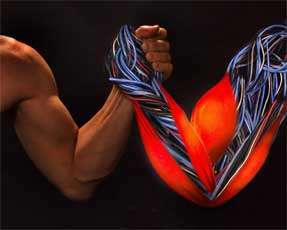
Six years ago a scientist at NASA's Jet Propulsion Laboratory in Pasadena, Calif., issued a unique challenge: build a robotic arm using artificial muscles that could arm wrestle a human. The results of that challenge will be determined next week, when three such robotic arms will "step into the ring" to compete against a 17- year-old high school student. The ultimate goal is to win against the strongest human on Earth.
When he issued the challenge, Dr. Yoseph Bar-Cohen, a physicist at JPL, wanted to jump-start research in electroactive polymers, also known as artificial muscles. He didn't expect to see the challenge fulfilled for at least a couple of decades. "Given the technology we had in 1999, I thought it would take at least 20 years before we could do it," said Bar-Cohen, who has been called the "Artificial Muscle Man."
But he was wrong, and next week's event is a big step forward in the development and testing of these technologies. If the robotic arm wins, it will open doors for many engineering technologies in medicine, military defense and even entertainment. "You have to ask whether science fiction drives reality, or reality drives science fiction," Bar-Cohen said.
The three artificial arms and their teams come from around the world. Researchers from New Mexico and Switzerland built arms made of plastics and polymers. A group of students from Virginia Tech University in Blacksburg, Virginia will also test their arm invention made of gel fibers and electrochemical cells.
The arm wrestling contest is one of the highlights at the Electroactive Polymer and Devices conference to be held March 7-10, at the Town and Country Resort & Convention Center in San Diego. The arm wrestling competition is March 7, from 5:00 to 6:00 pm in the Town & Country room at the convention center. The conference and competition are part of the Smart Structures and Materials symposium sponsored by the International Society for Optical Engineering.
Panna Felsen, a senior at La Costa Canyon High School in San Diego who has participated in student robotics competitions, will try to make the robotic arms buckle during the contest. "I'm really excited to be the human opponent, but I have no plans of making it easy for the arms to win against me," Felsen said. "The match will be a fair test of strength."
After the competition, eight organizations will demonstrate other applications using artificial muscles, including an android head that makes and responds to facial expressions, biologically inspired robotic mechanisms and windows that change colors electronically.
Electroactive polymers are simple, lightweight strips of highly flexible plastic that bend or stretch when put into contact with chemicals or electricity. They are quiet and shatterproof and can be used to imitate human muscle movements.
A small team of scientists at JPL, in cooperation with research centers worldwide, are working to turn these plastic strips into grippers and strings that can grab and lift loads. JPL engineers are also hoping to build a rover with legs fitted with artificial muscles. The robot would be able to walk instead of rolling on wheels on planetary surfaces. "My hope is to see a rover run like a horse on Mars and climb steep mountains like a monkey, allowing us to reach distances and heights that are not possible with wheeled rovers," said Bar-Cohen who has chaired the conference for the past six years. During the conference, he will receive the 2005 Smart Materials and Structures Lifetime Achievement Award.
Source: NASA


