NASA's Spitzer Space Telescope Exposes Dusty Galactic Hideouts
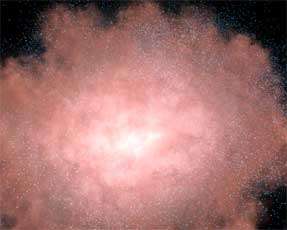
How do you hide something as big and bright as a galaxy? You smother it in cosmic dust. NASA's Spitzer Space Telescope saw through such dust to uncover a hidden population of monstrously bright galaxies approximately 11 billion light-years away.
These strange galaxies are among the most luminous in the universe, shining with the equivalent light of 10 trillion suns. But, they are so far away and so drenched in dust, it took Spitzer's highly sensitive infrared eyes to find them.
"We are seeing galaxies that are essentially invisible," said Dr. Dan Weedman of Cornell University, Ithaca, N.Y., co-author of the study detailing the discovery, published in today's issue of the Astrophysical Journal Letters. "Past infrared missions hinted at the presence of similarly dusty galaxies over 20 years ago, but those galaxies were closer. We had to wait for Spitzer to peer far enough into the distant universe to find these."
Where is all this dust coming from? The answer is not quite clear. Dust is churned out by stars, but it is not known how the dust wound up sprinkled all around the galaxies. Another mystery is the exceptional brightness of the galaxies. Astronomers speculate that a new breed of unusually dusty quasars, the most luminous objects in the universe, may be lurking inside. Quasars are like giant light bulbs at the centers of galaxies, powered by huge black holes.
Astronomers would also like to determine whether dusty, bright galaxies like these eventually evolved into fainter, less murky ones like our own Milky Way. "It's possible stars like our Sun grew up in dustier, brighter neighborhoods, but we really don't know. By studying these galaxies, we'll get a better idea of our own galaxy's history," said Cornell's Dr. James Houck, lead author of the study.
The Cornell-led team first scanned a portion of the night sky for signs of invisible galaxies using an instrument on Spitzer called the multiband imaging photometer. The team then compared the thousands of galaxies seen in this infrared data to the deepest available ground-based optical images of the same region, obtained by the National Optical Astronomy Observatory Deep Wide- Field Survey. This led to identification of 31 galaxies that can be seen only by Spitzer. "This large area took us many months to survey from the ground," said Dr. Buell Jannuzi, co-principal investigator for the Deep Wide-Field Survey, "so the dusty galaxies Spitzer found truly are needles in a cosmic haystack."
Further observations using Spitzer's infrared spectrograph revealed the presence of silicate dust in 17 of these 31 galaxies. Silicate dust grains are planetary building blocks like sand, only smaller. This is the furthest back in time that silicate dust has been detected around a galaxy. "Finding silicate dust at this very early epoch is important for understanding when planetary systems like our own arose in the evolution of galaxies," said Dr. Thomas Soifer, study co-author, director of the Spitzer Science Center, Pasadena, Calif., and professor of physics at the California Institute of Technology, also in Pasadena.
This silicate dust also helped astronomers determine how far away the galaxies are from Earth. "We can break apart the light from a distant galaxy using a spectrograph, but only if we see a recognizable signature from a mineral like silicate, can we figure out the distance to that galaxy," Soifer said.
In this case, the galaxies were dated back to a time when the universe was only three billion years old, less than one-quarter of its present age of 13.5 billion years. Galaxies similar to these in dustiness, but much closer to Earth, were first hinted at in 1983 via observations made by the joint NASA-European Infrared Astronomical Satellite. Later, the European Space Agency's Infrared Space Observatory faintly recorded comparable, nearby objects. It took Spitzer's improved sensitivity, 100 times greater than past missions, to finally seek out the dusty galaxies at great distances.
The National Optical Astronomy Observatory Deep Wide-Field Survey used the National Science Foundation's 4-meter (13-foot) telescope at Kitt Peak National Observatory, located southwest of Tucson, Ariz.
Source: NASA


