Tiny holes offer surprising insights
Researchers from Berlin and Seoul store light in plasmonic crystals
Light can creep through tiny holes in a metal plate, even if those holes are smaller in diameter than the wavelength of light. What’s more, the light is stored for a short period of time on the metal surface, as if the metal were a photonic crystal. The controlled interaction of light with such metal structures could pave the way to unique methods for nanosensing or nanoscale information transfer, write Claus Ropers and colleagues in the forthcoming issue of Physical Review Letters ("Femtosecond light transmission and subradiant damping in plasmonic crystals").
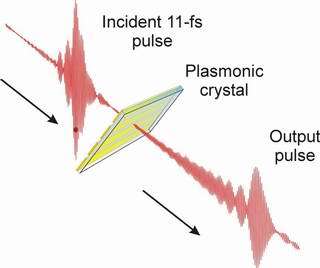
Fig. 1. Experimentally measured time-structure of the electric field of an 11-fs optical pulse incident on a 800-nm period array of 50-nm wide slits in a thin gold film and on the transmitted output pulse.
In their experiments conducted at the Max Born Institute in Berlin, Ropers and colleagues aim an ultrashort laser pulse at a nanostructured metal surface. The initial laser pulse measures 10 femtoseconds. As the light hits the surface, it drives electron oscillations and generates surface-bound electromagnetic waves, known as surface plasmon polaritons.
These surface plasmon polaritons cause an unusually high transmission through sub-wavelength apertures, i.e. the tiny holes, or travel along nanometric waveguides. These phenomena evolve on an extremely short time scale and have so far refrained from any direct time-resolved observation. Now, researchers at the Max-Born-Institute in Berlin, Germany and at Seoul National University in Korea, report on a new experiment to measure the polariton lifetime by tracking amplitude and phase of extremely short, 10-fs laser pulses while they are transmitted through a plasmonic crystal, a periodic array of nanometer-sized slits in a thin metal film (Fig. 1). They find lifetimes reaching up to 300 fs, more than an order of magnitude larger than previously thought.
This surprising finding can be tracked down to the microscopic spatial structure of the plasmon field (Fig. 2), which displays symmetric (cosine-like) and antisymmetric (sine-like) plasmon modes, depending on excitation wavelength. The latter display a strongly reduced overlap with the nanoslit scattering centers, which inhibits the emission of electromagnetic radiation and therefore reduces radiative damping of the plasmon field.
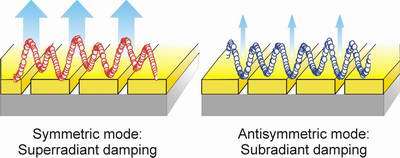
Fig. 2. Microscopic spatial structure of the surface plasmon polarition in the near-field of an 800-nm period nanoslit array in a thin gold film at a wavelength corresponding to (left) enhanced superradiant damping and (right) reduced subradiant damping of the plasmon field.
These experiments devise a way to control surface plasmon radiation by tailoring their spatial mode profiles, an important prerequisite for using plasmonic crystals in nanosensing, or waveguiding applications or even as flying qubits in quantum information processing.
Source: Forschungsverbund Berlin e.V. (FVB)
For more information please contact:
Dr. Christoph Lienau
Max-Born-Institut für Nichtlineare Optik und Kurzzeitspektroskopie
Max-Born-Str 2A
D-12489 Berlin
Phone: +49-30-6392-1476
Mail: lienau@mbi-berlin.de


