Finger length predicts physically aggressive personalities, study shows
March 4, 2005 Finger length predicts physically aggressive personalities, study shows

Dr. Peter Hurd initially thought the idea was "a pile of hooey," but he changed his mind when he saw the data.
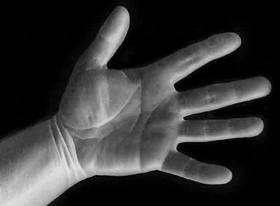
Hurd and graduate student Allison Bailey have shown that a man's index finger length relative to ring finger length can predict how inclined that man is to be physically aggressive. Women do not show a similar effect.

A psychologist at the University of Alberta, Hurd said that it has been known for more than a century that the length of the index finger relative to the ring finger differs between men and women. More recently, researchers have found a direct correlation between finger lengths and the amount of testosterone that a fetus is exposed to in the womb. The shorter the index finger relative to the ring finger, the higher the amount of prenatal testosterone, and – as Hurd and Bailey have now shown – the more likely he will be physically aggressive throughout his life.

"More than anything, I think the findings reinforce and underline that a large part of our personalities and our traits are determined while we're still in the womb," said Hurd.

Hurd and Bailey's research, published this month in Biological Psychology, was determined from surveys and hand measurements of 300 U of A undergraduates.

In their study, they found there were no correlations between finger lengths and males who are prone to exhibit verbally aggressive, angry, or hostile behaviours, but there was to physically aggressive behaviour.

Hurd is conducting ongoing research in this area, including a study that involves measuring hockey players' finger lengths and cross-referencing the results with each player's penalty minutes. He also has a similar study showing that men with more feminine finger ratios are more prone to depression; a paper on this will be published later this year in the journal Personality and Individual Differences.

"Finger lengths explain about five per cent of the variation in these personality measures, so research like this won't allow you to draw conclusions about specific people. For example, you wouldn't want to screen people for certain jobs based on their finger lengths," Hurd said. "But finger length can tell you a little bit about where personality comes from, and that's what we are continuing to explore."

Source: University of Alberta


print this article email this article download pdf blog this article bookmark this article     Stumble it Digg this share on Facebook retweet share on Reddit add to delicious
Rate this story - 2 /5 (2 votes)


March 4, 2005 all stories

Comments: 0

2 /5 (2 votes)
  • Stumble this up

  • Digg this

  • share this

  • hide
  • Related Stories


Other News

National anti-gun violence program largely successful, study finds

Other Sciences / Social Sciences

created 1hour ago | popularity 5 / 5 (1) | comments 0

Project Safe Neighborhoods - a community-based policing effort launched in 2001 - has been largely successful in its goal of reducing violent crime, according to an analysis by Michigan State University, the national research ...


Failing the sniff test: Researchers find new way to spot fraud

Other Sciences / Economics

created 7 hours ago | popularity not rated yet | comments 1

Companies that commit fraud can find innovative ways to fudge the numbers, making it hard to tell something is wrong by just looking at their financial statements. But research from North Carolina State University unveils ...


Remains of Minoan-style painting discovered during excavations of Canaanite palace

Other Sciences / Archaeology & Fossils

created 4 hours ago | popularity 4.5 / 5 (2) | comments 0

The remains of a Minoan-style wall painting, recognizable by a blue background, the first of its kind to be found in Israel, was discovered in the course of the recent excavation season at Tel Kabri. This fresco joins others ...


RIT scholars explore the impact of imaging on our reality

Other Sciences / Social Sciences

created 2 hours ago | popularity not rated yet | comments 0

Imaging is the use of machines to enhance humans' ability to perceive things, often by producing visible phenomena that cannot be seen with the naked eye. But, can imaging technology distort reality and even change what humans ...


Forest clearances sealed ancient civilisation's downfall

Forest clearances sealed ancient civilisation's downfall

Other Sciences / Archaeology & Fossils

created Nov 02, 2009 | popularity 4.9 / 5 (9) | comments 6

(PhysOrg.com) -- An ancient South American civilisation which disappeared around 1,500 years ago helped to cause its own demise by damaging the fragile ecosystem that held it in place, a study has found. ...