Surprising news about black holes
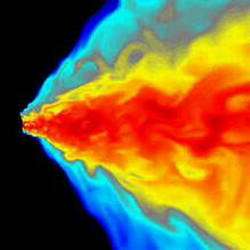
Computer reveals that life around black holes is turbulent and violent
For more than 30 years, astrophysicists have believed that black holes can swallow nearby matter and release a tremendous amount of energy as a result. Until recently, however, the mechanisms that bring matter close to black holes have been poorly understood, leaving researchers puzzled about many of the details of the process.
Image: Computer simulations of how black holes swallow matter show surprising violence and turbulence.
Now, however, computer simulations of black holes developed by researchers, including two at The Johns Hopkins University, are answering some of those questions and challenging many commonly held assumptions about the nature of this enigmatic phenomenon.
"Only recently have members of the research team -- John Hawley and Jean-Pierre De Villiers, both of the University of Virginia -- created a computer program powerful enough to track all the elements of accretion onto black holes, from turbulence and magnetic fields to relativistic gravity," said Julian Krolik, a professor in the Henry A. Rowland Department of Physics and Astronomy at Johns Hopkins and co-leader of the research team. "These programs are opening a new window on the complicated story of how matter falls into black holes, revealing for the first time how tangled magnetic fields and Einsteinian gravity combine to squeeze out a last burst of energy from matter doomed to infinite imprisonment in a black hole."
Close to the black hole's outer edge, where the Newtonian description of gravity breaks down, ordinary orbits are no longer possible. At that point -- or so it has been imagined for the past three decades -- matter plunges quickly, smoothly and quietly into the black hole. In the end, according to the prevailing picture, the black hole -- except for exerting its gravitational pull -- is a passive recipient of mass donations.
The team's first realistic calculations of matter falling into black holes have strongly contradicted many of these expectations. They show, for instance, that life in the vicinity of a black hole is anything but calm and quiet. Instead, the relativistic effects that force matter to plunge inward magnify random motions within the fluid to create violent disturbances in density, velocity and magnetic field strength, driving waves of matter and magnetic field to and fro. This violence can have observable consequences, according to research team co-leader Hawley.
"Just like any fluid that has been stirred into turbulence, matter immediately outside the edge of the black hole is heated. This extra heat makes additional light that astronomers on Earth can see," Hawley said. "One of the hallmarks of black holes is that their light output varies. Although this has been known for more than 30 years, it has not been possible to study the origins of these variations until now. The violent variations in heating -- now seen to be a natural byproduct of magnetic forces near the black hole -- offer a natural explanation for black holes' ever-changing brightness."
One of the most striking properties of a black hole is its ability to expel jets at close to the speed of light. While it has long been expected that magnetic fields are crucial to this process, the latest simulations show for the first time how a field can be expelled from the accreting gas to create such a jet.
Perhaps the most surprising result of the team's new computer simulations is that the magnetic fields brought near a rotating black hole also couple the hole's spin to matter orbiting farther out, in the same way that a car's transmission connects its rotating motor to the axle. Says Krolik, "If a black hole is born spinning extremely rapidly, its 'drive train' can be so powerful that its capture of additional mass causes its rotation to slow down. Accretion of mass would then act as a 'governor,' enforcing a cosmic speed limit on black hole spins."
According to Krolik, that "governor" may have strong implications for many of the most striking properties of black holes. It is widely thought, for example, that the strength of a black hole's jet is related to its spin, so a "spin speed limit" might determine a characteristic strength for the jets, Krolik said.
Source: Johns Hopkins University


