Oldest Fossil Protein Sequenced
Protein sequence from Neanderthal extracted and sequenced
An international team, led by researchers at the Department of Human Evolution, Max Planck Institute for Evolutionary Anthropology, in Leipzig, Germany, have extracted and sequenced protein from a Neanderthal from Shanidar Cave, Iraq dating to approximately 75,000 years old. It is rare to recover protein of this age, and remarkable to be able to determine the constituent amino acid sequence. This is the oldest fossil protein ever sequenced. Protein sequences may be used in a similar way to DNA, to provide information on the genetic relationships between extinct and living species. As ancient DNA rarely survives, this new method opens up the possibility of determining these relationships in much older fossils which no longer contain DNA (PNAS Online Early Edition, March 8, 2005).
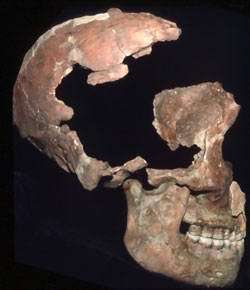
Image: The skull of the 75,000 year old Neanderthal from the Shanidar cave in Iraq. Credit: Erik Trinkaus
The research, published in PNAS, presents the sequence for the bone protein osteocalcin from a Neanderthal from Shanidar Cave, Iraq, as well as osteocalcin sequences from living primates (humans, chimpanzees, gorillas and orangutans). The team found that the Neanderthal sequence was the same as modern humans. In addition, the team found a marked difference in the sequences of Neanderthals, human, chimpanzee and orangutan from that of gorillas, and most other mammals. This sequence difference is at position nine, where the crystalline amino acid hydroxyproline is replaced by proline (an amino acid that is found in many proteins). The authors suggest that this is a dietary response, as the formation of hydroxyproline requires vitamin C, which is ample in the diets of herbivores like gorillas, but may be absent from the diets of the omnivorous primates such as humans and Neanderthals, orangutans and chimpanzees. Therefore, the ability to form proteins without the presence of vitamin C may have been an advantage to these primates if this nutrient was missing from the diets regularly, or from time to time.
This research opens up the exciting possibility of extracting and sequencing protein from other fossils, including earlier humans, as a means of determining the relationships between extinct and living species, and to better understand the phylogenetic relationships.
[SJ]
Original work:
Christina M. Nielsen-Marsh, Michael P. Richards, Peter V. Hauschka, Jane E. Thomas-Oates, Erik Trinkaus, Paul B. Pettitt, Ivor Karavanic, Hendrik Poinar, and Matthew J. Collins
Osteocalcin protein sequences of Neanderthals and modern primates
PNAS published March 7, 2005, 10.1073/pnas.0500450102
Source: Max Planck Institute


