Double volcanic eruption in Eastern Russia
March 10, 2005 Double volcanic eruption in Eastern Russia

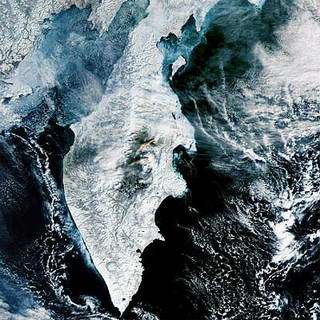
Acquired from orbit 800 kilometres away, this Envisat image shows two volcanoes erupting simultaneously on Russia's snowy Kamchatka Peninsula this week.
Located in the Russian Far East, the Kamchatka Peninsula is a landscape covered with volcanoes, part of the Pacific 'Ring of Fire'. Two stratovolcanoes, Kliuchevskoi and Shiveluch are currently erupting simultaneously.

Image: This 7 March 2005 Envisat MERIS image shows the unusual phenomenon of the simultaneous eruption of two stratovolcanoes, Kliuchevskoi and Shiveluch (or Sheveluch) on Russia's Kamchatka Peninsula. Stratovolcanoes are formed of alternating layers of pyroclastic materials and subordinate lavas. They have conical shapes and are built up by multiple eruptions. The lava produced during stratovolcano eruptions is typically andesitic, with fine grains and dark colour. Andesitic eruptions tend to be explosive, producing pyroclastic materials and in some cases 'ignimbrites' - fist-sized pumice fragments. The Reduced Resolution mode image has a 300 metre resolution. Credits: ESA

The more southerly 4835-metre-high Kliuchevskoi volcano began its latest eruption on 17 January 2005. By 7 March its consequent lava flow had reached the Erman glacier and started to melt it, causing a threat of potential mudslides. The hot volcanic material in contact with the surrounding ice and snow caused secondary explosions, hurling material as far as eight kilometres into the air.

Above it is Kamchatka's most northerly active volcano Shiveluch – also known as Sheveluch. It is 3283 metres high and started its latest eruption on 27 February 2005. The erupting material covers an area over 700 kilometres across with a layer of ash about 150 kilometres wide and eight centimetres thick, extending westward to the Okhotsk Sea. A ten-km-wide lava flow destroyed the Shiveluch seismological station, located about eight km from the volcano.

Russia's Novosti RIA news agency reports that the village of Klyuchi located between the two volcanoes is suffering periodic ash falls but is otherwise safe. Aviation is at greater threat, with volcanic ash particles capable of disabling aircraft engines: Kamchatka is on a major airline route, and aircraft have had to divert around eruptions in the past.

The image was acquired by Envisat's Medium Resolution Imaging Spectrometer (MERIS) in Reduced Resolution Mode, with a spatial resolution of 300 metres and a width of 1284 km. It was processed for ESA by Brockmann Consult.

Source: ESA


print this article email this article download pdf blog this article bookmark this article     Stumble it Digg this share on Facebook retweet share on Reddit add to delicious
Rate this story - 1.7 /5 (12 votes)


March 10, 2005 all stories

Comments: 0

1.7 /5 (12 votes)
  • Stumble this up

  • Digg this

  • share this

  • hide
  • Related Stories

  • Climate studies to benefit from 12 years of satellite aerosol data
    created Nov 10, 2009 | popularity not rated yet | comments 0
  • The Ultimate Long Distance Communication
    created Aug 19, 2009 | popularity not rated yet | comments 0
  • Aura Marks Five Years of Sky-High Atmosphere Research
    created Aug 05, 2009 | popularity not rated yet | comments 0
  • New map hints at Venus's wet, volcanic past (w/ Video)
    created Jul 14, 2009 | popularity not rated yet | comments 0
  • Volcanic activity on Mars could offer clues to planet's history
    created Jul 13, 2009 | popularity not rated yet | comments 0


Other News

Brazil: Deforestation sees biggest drop in 20 yrs (AP)

Brazil: Deforestation sees biggest drop in 20 yrs

Space & Earth / Environment

created 17 minutes ago | popularity not rated yet | comments 0

(AP) -- Deforestation in the Brazilian Amazon dropped nearly 46 percent from August 2008 to July 2009 - the biggest annual decline in two decades, the government said Thursday.


Discoveries in the Deep

Discoveries in the Deep

Space & Earth / Earth Sciences

created 1hour ago | popularity not rated yet | comments 0

Scientists from NASA and the Canadian Space Agency have been using Pavilion Lake as a testing ground for the future human exploration of other worlds.


2 Earth-sized bodies with oxygen rich atmospheres found -- but they're stars not planets

Two Earth-sized bodies with oxygen rich atmospheres found -- but they're stars not planets

Space & Earth / Astronomy

created 4 hours ago | popularity 4.8 / 5 (6) | comments 1

(PhysOrg.com) -- Astrophysicists at the University of Warwick and Kiel University have discovered two earth sized bodies with oxygen rich atmospheres - however there is a bit of a disappointing snag for anyone ...


Research gives new insights into 4 billion year-old meteorites

Research gives new insights into 4 billion year-old meteorites

Space & Earth / Astronomy

created 2 hours ago | popularity not rated yet | comments 0

(PhysOrg.com) -- Scientists have gained new insight into the makeup of ancient meteorites called Carbonaceous Chondrites, in research published in the October edition of the journal Earth Science and Planetary Le ...


NASA to Begin Attempts to Free Sand-Trapped Mars Rover

NASA to Begin Attempts to Free Sand-Trapped Mars Rover

Space & Earth / Space Exploration

created 3 hours ago | popularity not rated yet | comments 0

(PhysOrg.com) -- NASA will begin transmitting commands to its Mars exploration rover Spirit on Monday as part of an escape plan to free the venerable robot from its Martian sand trap.