Pluto's Horizon
In March 1930 the Lowell Observatory in Arizona announced the discovery of a small, odd world, roaming beyond the known planets in a region barely visible through the most powerful telescopes.
Seventy-five years later that historic find -- Pluto -- remains almost as much of a mystery as it was then. No spacecraft has ever visited it, and not even the Hubble Space Telescope can spot details on its rocky, icy surface. Yet with the New Horizons mission, now in development and planning for liftoff January 2006 from Launch Complex 41 at the Kennedy Space Center, NASA looks to unlock one of the solar system's last, great planetary secrets.
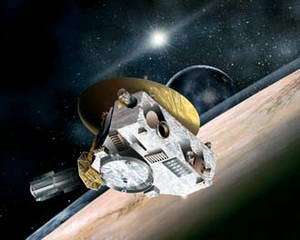
Image: Artist's concept of the New Horizons spacecraft during its planned encounter with Pluto and its moon, Charon. The craft's miniature cameras, radio science experiment, ultraviolet and infrared spectrometers and space plasma experiments would characterize the global geology and geomorphology of Pluto and Charon, map their surface compositions and temperatures, and examine Pluto's atmosphere in detail. The spacecraft's most prominent design feature is a nearly 7-foot (2.1-meter) dish antenna, through which it would communicate with Earth from as far as 4.7 billion miles (7.5 billion kilometers) away. Credit: NASA/JHUAPL/SwRI
"The United States has made history by being the only nation to reach every planet from Mercury to Neptune with a space probe," says New Horizons Principal Investigator Alan Stern, of the Southwest Research Institute, Boulder, Colo. "With New Horizons, the U.S. can complete the reconnaissance of the solar system and round out our knowledge of the planets."
After launch aboard an Atlas V, New Horizons would cross the entire span of the solar system -- in record time -- and conduct flyby studies of Pluto and its moon, Charon, in 2015. The seven science instruments on the piano-sized probe would shed light on the bodies' surface properties, geology, interior makeup and atmospheres.
It would mark humankind's first voyage into the "third zone" of the solar system known as the Kuiper Belt, populated by smaller, icy objects different than the rocky inner planets or the outer gas giants. The National Academy of Sciences placed the exploration of the third zone in general, and Pluto-Charon in particular, in its highest priority planetary mission ranking for this decade.
Planning for Launch
A Draft Environmental Impact Statement (DEIS) for the New Horizons mission has been released for a 45-day public comment period that ends April 11. The document is available on the Web at spacescience.nasa.gov/admin/pu … s/plutoeis/index.htm, or in the Kennedy Space Center library.
The power source for the spacecraft, a radioisotope thermoelectric generator (RTG), uses heat from the decay of plutonium dioxide to produce electricity. The DEIS examines potential environmental impacts under three scenarios: a normal launch; a launch accident with no radiological release from the RTG; and a launch accident involving a radiological release.
According to the DEIS, the most likely outcome is a successful launch. A less likely scenario, a non-radiological launch accident, would result in the same potential impacts as other expendable launch vehicle accidents. The least likely scenarios include an accident resulting in a radiological release, though safety studies indicate that most releases would not harm people.
On March 29 and 30, NASA will host meetings at the Florida Solar Energy Center in Cocoa, where the public can comment on the DEIS and learn more about the proposed mission and the steps NASA takes in deciding whether or not to conduct the launch. After these National Environmental Policy Act reviews, if NASA decides to proceed with the mission, the spacecraft would await presidential approval to launch next January.
Source: NASA


